Impending doom may not exactly mean imminent or even inevitable doom, but the trend is not a friend of institutions of higher education.
The signs are everywhere. Colleges and universities are having to slash prices; employers are looking askance at college graduates because they graduate without the skills needed to become good employees; and the once-useful sorting mechanism a credential could provide has become worse than useless.
US colleges slash tuition by tens of thousands as families balk at sky-high sticker prices https://t.co/FNaaTX3Clf https://t.co/wboqK9R5sQ
— New York Post (@nypost) October 5, 2026
College attendance skyrocketed after World War II with the G.I. Bill, and for a long time the advantages of going to college did too. College graduates made more, subsidies made it more accessible, and during Vietnam it was a shelter from the draft.
The baby boom was a boon for obvious reasons. More customers, and for decades that supercharged the rise.
College loans made it more affordable than ever, at least until the institutions realized that they could increase prices without driving customers away. State and federal subsidies had the predictable but perverse effect of reducing price sensitivity; the credential benefit increased the value, and the result was an explosion in revenue that colleges have ridden for decades.
Holy Shit. Talk about burying the lede. 'A Forbes survey found almost half of corporate executives are either less likely to hire Ivy League graduates than they were five years ago or would never hire them.' Saying 'We don't hire Ivy League' is a datum so flaming it's practically a blue-white star. Those are words I never expected to see written, especially in the WSJ. Worth reading: (Should be in a non-paywall form.) https://t.co/jvdtNmneri
— John Ringo SF Author (@Jringo1508) October 5, 2026
One underrated cause for the increasing value of colleges was the Supreme Court decision in Griggs v. Duke Power, which forced employers to drop standardized testing in their hiring process unless they could prove a direct connection to employee performance. The college degree served as a proxy for those tests, since the expectation was that college kids were smarter than the average.
Good times, man. Good times.
But now the trend is suddenly reversing, and institutions are getting hammered from all directions. And I am definitely here for it.
Suddenly, all the reasons why colleges and universities were flourishing have lost value or are reversing entirely. The baby boom turned into the baby bust; college loans are so burdensome that they have become a major political issue; exclusive college degrees are now looked at as a liability by some employers because the credential doesn't signal what it used to; and the curriculum is designed to make students anti-resilient and difficult to work with.
And then there is AI, which upends everything.
@shellenberger I address these and all the other data in my piece today about the fact that higher ed must adapt/reform, if anyone is interested: https://t.co/NGq9smgp68
— Kyle Saunders (@profgoose) October 1, 2026
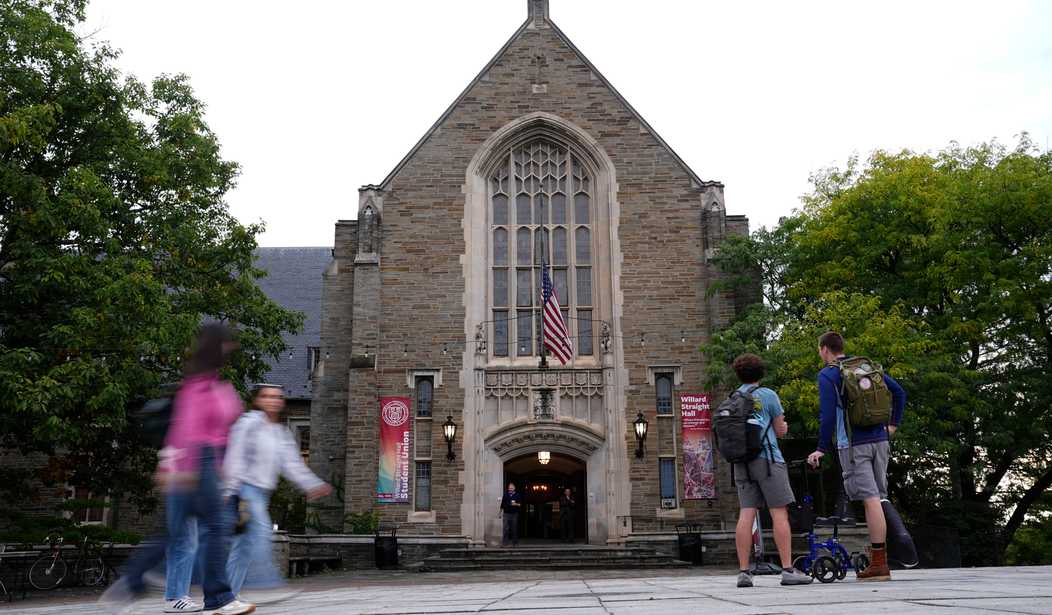
When a prestigious university like Cornell studies and finds that employers are reluctant to hire its graduates, that's a huge red flag and a market signal already working its way through the system as younger people consider going into the trades. Cornell found that employers believed that students arrived with a credential that should signal they are prepared, but the results proved they were anything but.
Add to that, what was initially a student complaint — that college doesn't pay off as it used to — is translating into a market adjustment in which students are opting out altogether.
The declining importance Americans place on a college education spans all major demographic groups. Since 2019, every group measured has seen a double-digit decline in the percentage saying college is very important. Full story: https://t.co/uYK7dRuHYR https://t.co/vUnXXipnvM
— Gallup (@Gallup) October 4, 2026
When prominent Wall Street Journal articles point out that both professors and students are becoming typists for chatbots, employers wonder why they need typists and what the heck professors are doing with their time other than plotting the downfall of Western civilization and capitalism.
As Andy Kessler put it in his WSJ piece, "Do ChatGPT-written essays get graded by Claude? Why bother?" Why pay $80,000 plus an AI subscription when you can just get the AI subscription, led by an already experienced employee?
And now the Trump administration has signaled that the "disparate impact" restrictions on testing will be loosened through enforcement, giving employers the potential to directly test applicants in a way they have been reluctant to for decades.
Employers have realized that universities' credentialing function no longer works, and now they are getting a signal that alternatives exist.
As a result, institutions of higher education are beginning to contract. Here in Minnesota, the Minnesota State Colleges and University system is in financial trouble and is considering closing campuses and even razing some infrastructure. Staffing is shrinking across institutions nationwide, and the number of majors is contracting.
None of this means the Ivies are going out of business — they still perform a social-class signaling function, at least for now, and they have financial resources most institutions could only dream of. And, of course, they occupy the "luxury brand" market, which is less sensitive to demand shocks, especially because demand for slots grossly outstrips supply. Even if applications go down, the number of addressable clients will remain above supply.
But that is only true for prestige institutions, where even reduced economic returns won't dent their enrollment.
Most institutions won't have that luxury. The total market is shrinking, along with the value they provide. That's deadly.
I am much less optimistic, if you can call it that, about colleges being able to address the decline. Kessler thinks these institutions could adjust their curricula to improve their situation and the students'. I personally doubt that. His suggestions have their own problems:
Three years ago, OpenAI’s GPT-4 scored 1,410 on the SAT, maybe enough to get into Michigan. Since then, AI has passed bar exams and medical licensing exams, which says more about these outdated tests than the inadequacy of humans, perhaps a sign of an antiquated education system. Even worse is a 2025 Harvard study, “AI tutoring outperforms in-class active learning.” Are teachers and professors becoming obsolete?
Universities can take advantage of AI rather than ban it. The sage-on-a-stage format is over. Learning is experiential. As corporate America rejects college branding, graduates would benefit from more hands-on experience. Universities may be uniquely positioned to implement what I call “virtual apprenticeships,” real job experience while still at school.
I suggest all students spend their entire junior year on team projects. Assignments might include building nuclear autonomous buses or robots that cook. Cross-discipline self-organizing teams will form. You’ll need engineers and coders, but also prelaw and political-science majors to clear the regulatory path, philosophers and marketing majors to write press releases, designers, nutritionists, etc.
Self-paced AI-tutored instruction can help students learn what they need as problems arise. A smart entrepreneur might even create a student transfer portal to recruit talented students from other universities.
Have you ever done a group project in college? If so, enough said. And nuclear autonomous buses are unlikely to solve the problems, no matter how cool that sounds.
And that doesn't even address the institutional and ideological barriers, which are so much of the problem. The people who run these places day to day actually don't want students to be prepared to become cogs in a machine they hate. Many of them see their job as destroying capitalism, not enabling students to participate in it better. Anyone teaching classes on "how to destroy the heteronormative patriarchy that imposes illegitimate gender standards" is not teaching them how to think critically and be resilient as an employee.
The only thing that could force reform is economic collapse, or at least a brush with death itself. If fiscal constraints become so tight that the administration can slash staff and get rid of the dead-weight professors, it would help a lot.
But in the meantime, at least some parallel institutions will spring up. They will focus less on theory and more on actual useful skills.
That won't solve the miseducation of the elites, which is a problem in itself. But it would be a start.
Editor's Note: Do you enjoy HotAir's conservative reporting that takes on the radical Left and woke media? Support our work so that we can continue to bring you the truth.
Join HotAir VIP and use promo code FIGHT to receive 60% off your membership.







Join the conversation as a VIP Member