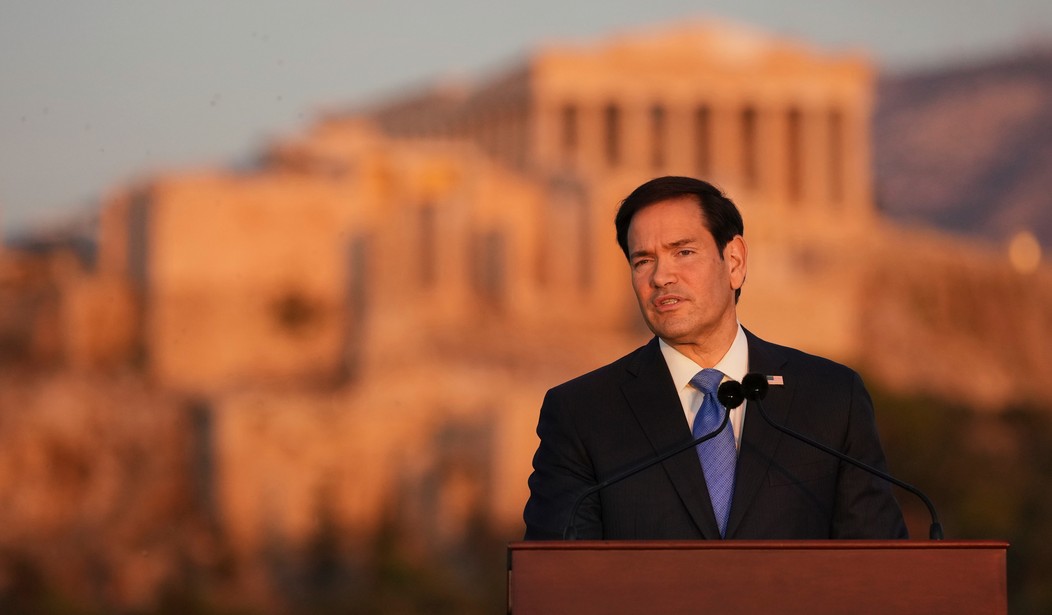
Well, I guess the secret is out. Marco Rubio is a big fan of mine.
I know this because his wonderful speech, delivered with the Acropolis in the background, touches on many themes I explore regularly in my posts.
I'm kinda shocked he didn't call me to get my thoughts before he delivered it. I would have taken his call.
SECRETARY RUBIO: We should marvel at what our forefathers carved out of this countryside. The story of our civilization is the greatest story ever known to man. And it began here, with the first men and women of the West. From them, from them we can rediscover the virtues, the courage, and the strength to confront the dangers that we face in our time.
— Department of State (@StateDept) October 7, 2026
Of course, I could be wrong. It could just be that great minds think alike, but I prefer my version of events, so I am sticking to it. I can engage in a bit of Narrative™ building now and then, can't I?
Seriously, Rubio's speech was masterful, both in its substance and because it articulates the issues at stake in the battle between the defenders of Western Civilization and the transnational elites who immediately attacked it. And, as is their wont, they did so both on its substance and with characteristic dishonesty, rewriting the speech or reframing it as proto-fascist.
I will embed the entire speech, but I suspect that most of you didn't come here to watch a 30-minute video; you want the analysis.
We believe that the West can awaken from its long slumber – and rekindle the fire that was first lit in ancient Greece millennia ago. https://t.co/gOi8VFQZgt
— Secretary Marco Rubio (@SecRubio) October 7, 2026
Rubio's theme is that the people I call the "transnationalists" have turned their backs on the core history and traditions of Western Civilization as it emerged in Classical Greece, and that the Trump administration aims to recapture the soul and spirit of what made the West great.
I'm pretty certain that is not how Trump would put it; his style is a bit rougher and readier than Rubio's, but in substance I think that is correct.
And what is that spirit? What virtues and impulses define the West? Ambition, exploration, competition (agon), the belief that the cosmos can be known, and thumos, which is commonly understood as something akin to "fire in the belly" or passion.
The Greeks saw in Persia a mirror image, in the sense of being the reverse of, the Achaemenid Empire founded by Cyrus the Great. The Greeks valued freedom and individual excellence, while all Persians but the Great Emperor were slaves, cogs in the machine. Whether that fairly characterizes the Persians is not the point; this self-definition shaped Greek civilization and its inheritors in the West.
"Too often these days, we build downwards. We design our standards to ensure no one will lose; we preoccupy ourselves more with the comfort of the worst than the potential of the best. We hold the most exceptional things among us hostage to the average, the ordinary, the mediocre."
Rubio calls for what amounts to a second Renaissance, rejecting technocratic rule and the obsession with critique, and refocusing on building greatness. That includes expanding our civilization, not retracting and replacing it with something that makes each of us smaller.
“But Europeans and our friends across the West must relearn the lessons our forefathers took from this place and from its history.”
“The history of Greece does not just offer us a glimpse of our institutions in the earliest forms. The history of Greece shows us an image of ourselves.”
“It shows us that ours is the inheritance of great heroes and we should be proud, intensely proud, where we come from.”
“We should marvel at what our forefathers carved out of this countryside.”
“The story of our civilization is the greatest story ever known to man, and it began here with the first men and women of the West, from them, from them we can rediscover the virtues, the courage and the strength to confront the dangers that we face in our time.”
The archetypal Greek hero was Achilles, whom people modeled themselves after. The archetypal Greek polis was Athens, through which we know all the others. The Spartans left a mark on history, but we know their society mostly through outsiders, Athenians above all, who gave us great art, philosophy, and literature. The Athenians gave us our history and, in vital ways, tutored Rome and birthed what we call Christendom.
"The thumos, as the ancient Greeks called it – the fire of passion, strength, courage, pride – is the heart of great civilization. And without it? Without it, nations lose their will to fight, the will to strive, the will to survive."
The argument that set off the leftist criticism of Rubio's speech is the unapologetic defense of nationalism and expansionism, to the point of celebrating our expansionism. The West, when it was self-confident, was indeed colonialist, not just out of self-interest, but because we believed only Western values could help all human beings reach their potential for greatness. Again, whether that is true in every case is not the point; human beings are fallen, and we rarely embody our aspirations in every respect, just as few Greeks reached the ideal of Achilles.
As our founding myth, the Classical spirit has guided us.
"The word 'nationalism' became a dirty word. And so we tore down our monuments; we condemned our own history. And in too many places, we taught our children to be ashamed of the countries they would inherit."
Rubio even embraced the great villain of our age: Cortés. Not because Cortés was the ideal Westerner, but because his accomplishments as a conqueror created the conditions that reshaped two continents and birthed the United States.
"And the qualities that led Alexander to conquer the entire known world reappeared in Caesar, then Charlemagne, and Cortes. ... The civilization of Athens and Rome transformed an infant seaboard republic into a continental empire."
Those sentences directly rebuke the modern, or should I say postmodern, Platonic Ideal of Western Civilization. Where they see oppression and evil, Rubio argues that he and our civilization's defenders see the necessary conditions for building greatness and a society that elevates liberty, allowing individuals to thrive and achieve greatness.
The United States inherited that tradition, even more than Europe. As spiritual descendants of the British Empire, the best inheritor of the classical tradition until we came along, we took that spirit, sharpened it, and burnished it into something truly great, making us the best civilization in world history. A civilization that literally reached for the moon and grasped it.
"Many, many people are surprised to learn that the most commonly cited author in the Federalist Papers was not an Enlightenment philosopher or political theorist. No, the most commonly cited author in the Federalist Papers was Plutarch."
(Actually, Montesquieu was quoted more, but that is a detail.)
Every word offended the sensibilities of the transnational elite, who recoiled in horror at his unapologetic defense of our history and our ethos. Where Rubio saw greatness, they saw evil. Where Rubio explains why Columbus was not a world-historic criminal, Rubio celebrates a spirit that took two continents still dominated by Stone Age civilizations and shaped one into the embodiment of the Classical ideals reborn.
A trip through Washington, D.C. will remind you that our Founders saw us as inheritors of Classical ideals. The very architecture shouts this to us.
Gift link to my @nytimes story: https://t.co/4msNMiB2Ya
— Edward Wong (@ewong) October 8, 2026
The New York Times only heard the worst of our history and trashed the speech, as did The New Republic. Many of our European allies heard much the same, because they have turned their backs on the West, literally importing the values and populations of those who hate us with a passion.
Secretary of State Marco Rubio called on Wednesday for Western nations to rejuvenate their civilization so they can maintain their dominance in a world of wars, economic uncertainty and technological change.
Rubio rebukes them as small men with small dreams, as is clearly true. Instead of embracing the spirit of liberty and the confidence to reach for greatness, they retreat into an ethos of managed decline and preparation for replacement.
It is an ugly vision, handing over a once-great continent to medieval barbarians. We should reject it emphatically.
Editor’s Note: Here at HotAir, we’ve been dealing with real government suppression of free speech for YEARS. Despite the threats and consequences, we refuse to go silent and remain committed to delivering the truth.
Help us fight back against government censorship by joining HotAir VIP and using promo code FIGHT to receive 60% off your membership.








Join the conversation as a VIP Member