"Affordability" is one of those words that gets thrown around a lot without being well-defined, but we all have a general idea of what it means.
Every election year, the economy, and by extension affordability, is always at the top of voters' concerns. Most years it is #1, and it is always in the top three, and for good reason: when we think of the "American Dream," we most often think of an ever-rising standard of living for families and their children.
As Reagan put it succinctly, "Are you better off now than you were four years ago?"
Many government policies directly affect "affordability," ranging from fiscal policy, taxes, interest rates, and the deficit to decisions like going to war. But others are less obvious, and Marc Andreessen does a wonderful job explaining structural problems the government creates without people understanding their impact.
Marc Andreessen reveals why housing, health care, and education keep getting more expensive while everything else gets cheaper "There's basically three components to the American dream. A house near great job opportunities, great health care for you and your family, and sending your kids to good schools" "If you disaggregate the economy over the last 25 years, everything that technology touches basically collapses in price. Television sets, computer games, anything with electronics in it. But if you chart housing, education, and health care, the prices of those things are skyrocketing" "The government restricts supply, zoning laws and university certifications. And then the government responds to the political pressure caused by the rising prices by subsidizing demand. And of course, if you subsidize demand and a fixed supply, you get skyrocketing prices"
— Jaynit (@jaynitx) October 13, 2026
Marc Andreessen reveals why housing, health care, and education keep getting more expensive while everything else gets cheaper
"There's basically three components to the American dream. A house near great job opportunities, great health care for you and your family, and sending your kids to good schools"
"If you disaggregate the economy over the last 25 years, everything that technology touches basically collapses in price. Television sets, computer games, anything with electronics in it. But if you chart housing, education, and health care, the prices of those things are skyrocketing"
"The government restricts supply, zoning laws and university certifications. And then the government responds to the political pressure caused by the rising prices by subsidizing demand. And of course, if you subsidize demand and a fixed supply, you get skyrocketing prices"
One point I have made over the years, to varying degrees of success, is that the areas of the economy with the most persistent inflation are in sectors where government plays an especially large role. Andreessen points to the three that most directly affect us in our day-to-day lives, and in all three, government is perhaps the largest contributor to inflation in prices
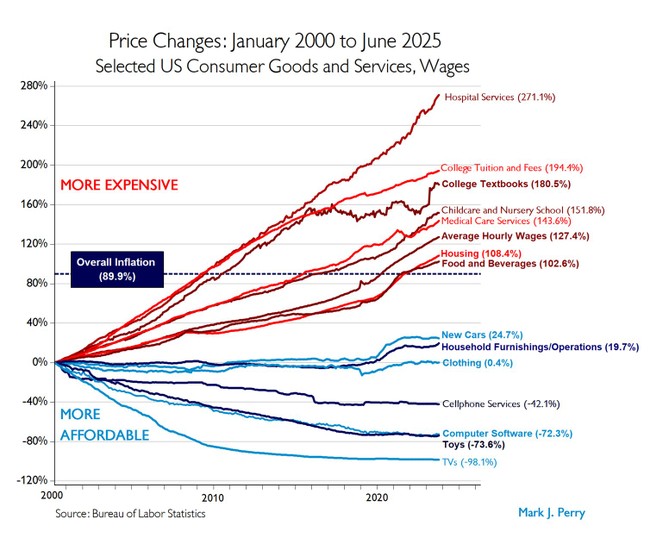 If you look at that chart, one thing is clear: the more involved government is in an industry, the more expensive it is and the higher inflation will be.
As a corollary, the higher the inflation in a sector of the economy, the more political pressure there is for the government to "do something" about it, which means messing with it even more.
Milei, for instance, proved what any economist could tell you about housing prices: lifting government price controls will expand the supply of housing and reduce prices. Yet here in the United States, the impulse today is the same as it was in Argentina for years: have the government control the housing market to make it more "affordable."
Of course, temporary price spikes from supply or demand shocks are generally not the government's fault, but persistent, high inflation is driven by government interference in the economy. The government spends about half of all healthcare spending, and its regulations affect all healthcare prices. Colleges and universities would collapse without government spending, and politicians have been pushing "college for all" my entire life. Hence the rapid expansion of prices. Child care, ditto.
In areas where the government spends almost all the money, such as K-12 education, the quality sucks and the prices, hidden in taxes, are astronomical.
Obviously, we can't do without government completely, but until we realize that government intervention in the economy is enormously costly and should be limited to the absolute necessities, "affordability" will only get worse.
Unfortunately, this is not "common sense" to most people because they only see the prices rise and assume that government subsidies will lower the prices. This is the opposite, at least in the long run. Even in healthcare, where people assume prices rise because of increasing technology and sophistication, that's not really true. Healthcare purchased directly by consumers tends to decrease in price over time.
Look at LASIK surgery. There's competition in that market, and people price out what it will cost because it matters to them. Generally speaking, nobody prices the cost of a bypass surgery because somebody else is paying.
When Henry David Thoreau said, "That government is best that governs least," he was more right than he knew.
Editor's Note: The Democrat Party has been infected by socialism, and it's spreading FAST. Democrats are claiming there's nothing to worry about, but we know the truth.
Help us continue to shine a light on the socialist takeover by joining HotAir VIP. Use promo code FIGHT to get 60% off your VIP membership.








Join the conversation as a VIP Member