
There is a striking parallel in two cases involving accusations of rape, both of which became national causes for the victimhood Left.
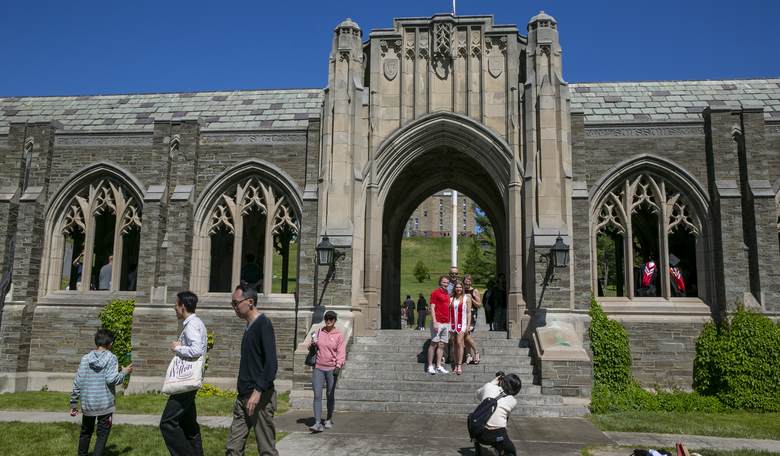
The one we are talking about now is the infamous "Cornell 7" case, where the legal processes all pointed to a lack of evidence to prosecute the accused and plenty of evidence suggesting that the story was more complicated than the media narrative portrayed.
The other, you may recall, is the so-called "Mattress Girl" case, in which Emma Sulkowicz accused a man of raping her, but both Columbia University and the police found that there was insufficient evidence to prosecute him, and contradictory evidence that cast doubt on Sulkowicz's story.
In neither case do I pretend to know all the circumstances behind closed doors, and neither does anyone else, aside from the participants. But in both cases, institutions that looked into the cases and are not known for going easy on rapists decided that the evidence did not back up the accusations. In Sulkowicz's case, even Columbia University, which does not need to follow the rules of evidence and presumption of innocence, decided her story did not hold up to scrutiny.
Sulkowicz earned the nickname "Mattress Girl" because her senior project involved carrying a mattress around the University campus to protest the injustice she felt she endured.
Reminds me of the Canadians who keep creating content around Christians burying babies under churches even though everyone knows it's bullshit.
— Theo Jordan (@Theo_TJ_Jordan) October 13, 2026
What is striking about these cases, as with the case that Theo Jordan refers to (the hoax of residential school mass graves), is the willingness of the cultural elite institutions, and especially the media, to ignore the evidence and stick with a Narrative™ despite the complete lack of evidence to support it.
The residential school hoax has been disproven, pretty conclusively, yet the Canadian government wants to prosecute "denialism," making it illegal — literally illegal — to tell the truth about what happened. Its goal has nothing to do with the truth; it's to ensure that a story that backs their ideological priors becomes the approved Narrative™.
I don't know what happened in that Cornell dorm room, but the evidence that a rape happened is scant and contradictory, based solely on the changing story of the presumed "victim." I know what happened was disgusting and never should have happened, but it is unclear that it was not consensual sex. The prosecutor definitely thought it was not provable rape. And the new prosecutor, Letitia James, stated her conclusion before even a cursory investigation, so we already know she will not be objective.
The Sulkowicz case is somewhat clearer, though I still wouldn't call her a "hoaxer," as many do. Rather, she has accepted the feminist definition of "consent," that it comes down to feelings, and as feelings change over time, "consent" can shift from "yes" to "no," even long after the event. Her sense of regret, even if it arose long after the event itself, is the only definition that matters.
It's the "feelings" over facts definition, which also happens to place the power of life and death over men in the hands of a woman who can change her mind over time.
Our full interview here https://t.co/T50v75tdBO
— Tara Palmeri (@tarapalmeri) October 12, 2026
Columbia, though, implicitly admitted that it had mistreated the accused when it settled with him for an undisclosed sum. His claim against them was based on the fact that by allowing Sulkowicz to get college credit for accusing him of a rape that the university itself said he was not responsible for, it had violated his rights. The University agreed.
In all these cases, the important point is this: in the larger cultural elite, whether one counts as a "victim" has little to do with any actual events; it has to do with immutable characteristics or intersectional victimhood status.
Jane Doe is presumed to be telling the truth, despite ambiguous evidence, and Sulkowicz is trotted out as a woman wronged, despite there being no corroborating institutional finding to back it up.
In all three cases, the evidence suggests either a hoax, as in the residential school controversy, or that the evidence does not unambiguously support the claims, as in the Cornell and Columbia cases.
In other words, facts and the truth matter less than the story that needs to be told. The goal is not fact-finding at all, but fighting the social justice war.
"You have to pause all jokes now, we're doing one of our society-wide female hysterias" "Okay, when do you plan to be finished with that?" "Finished?"
— Lukas (computer)🛡️ (@SCHIZO_FREQ) October 13, 2026
This is the problem with slogans like "believe all women." The presumption is that women are always victims and men are always perpetrators, and that is evidence enough. It was the same sort of dynamic that forced us to endure months of Jussie Smollett's hoaxing, and that Canadians must deal with when forced to acknowledge the falsehoods around the residential school false-massacres.
Well, facts do matter. Or at least they should. And the media are supposed to be a truth-finding institution, at least according to their self-description.
Unfortunately, they are advocates, and we should understand them as such. They are Ben Crump in Perry Mason clothes.