Alternate headline: Help Is On the Way. Really.
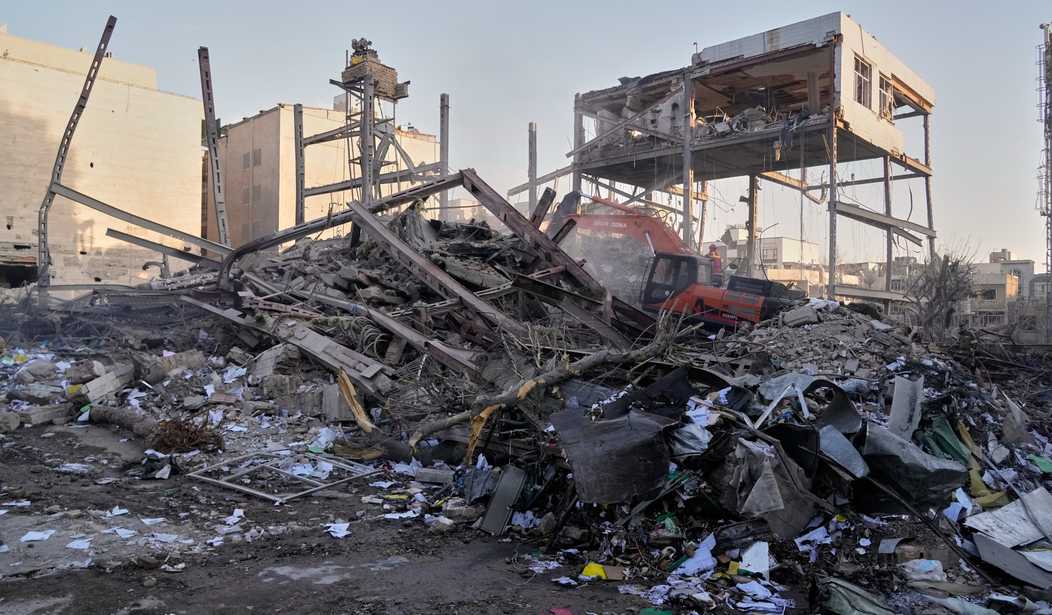
The Wall Street Journal reported last night that the promised escalation by the US and Israel now includes the targeting of the forces that arguably triggered Donald Trump’s red-line declaration two months ago. The Israelis in particular will now target the Basij and Revolutionary Guard command centers, both of which took part in the massacres of protesters in January. The strategy intends to clear the field for a new popular uprising in Tehran and other cities that could topple the mullah’s brutal regime:
Israel’s military is targeting the Iranian police state that brutally suppressed protests and killed thousands of people, with the hope of clearing the way for a popular revolt to overthrow the Islamic government.
Israeli airstrikes have targeted people responsible for internal security, from members of the Basij paramilitary force to senior intelligence officials, the Israeli military said. The U.S. has also hit some domestic-security agencies, including the Tehran headquarters of the Islamic Revolutionary Guard Corp, the powerful group responsible for defending and perpetuating the regime.
The Revolutionary Guard and Basij militants were the main perpetrators of the bloody crackdown against antigovernment protesters in January. They opened fire on crowds, killing thousands in one of the deadliest acts of political crackdowns worldwide in decades. Police units and intelligence services also suppressed rallies and arrested protesters en masse.
Israeli officials have made it clear they are looking to do enough damage to Iran’s police state from the air that the people can take over on the ground. While Israel has long been content to weaken Tehran with military action or covert operations, Israeli officials have concluded they now must push for regime change.
Up until now, the US-Israeli attack plan has mainly focused on the threats the regime can direct to outsiders – American and Israeli interests, Sunni Arab nations allied with us, international shipping, and so on. We have also focused on destroying regime leadership and its command dns control functions, but again, mainly in terms of controlling the levers of those outward-bound threats: terrorism, drones, ballistic missiles, and the Iranian navy.
After four days, attention and intention have finally turned to the mechanisms of internal oppression in Iran. Isn’t that what “help is on the way” meant? The point of the “red line” was to extend protection over the protesters that threatened the regime even at the relative zenith of their strength before the war. The mullahs sent the Basij and RG forces out to commit mass murder because those street protests posed a very clear and potentially existential threat to their grip on power.
This is why Trump went out of his way yesterday to emphasize that the time for a new popular uprising had not yet arrived. The Basij and RG units focused on enforcing the police state had not yet taken enough damage to risk another unarmed popular revolt. This phase will seek to destroy the internal police functions that led to the deaths of 32,000 or more unarmed Iranians.
The WSJ sounds skeptical about this plan:
“If the bet is that airstrikes will finish the job from above while Iranians complete it from below, it’s a bet that rests on no clear historical model,” said Ali Vaez, director of the Iran project at the International Crisis Group. “It also ignores the resilience of entrenched authoritarian systems like the Islamic Republic.”
Actually, we do have one clear historical model. Barack Obama’s seven-month campaign against Moammar Qaddafi did weaken that dictator enough so that a revolt finally pulled down his regime. That, however, was an armed revolt, as the people Obama purported to protect were militias and terror-linked groups that had launched a civil war. That model produced a failed state, of course, which is an outcome that Trump and his team need to prevent if at all possible.
The White House apparently is flirting with using an armed group to undergird a popular revolt and force the regime into collapse. The problem is that the only option at hand is the Kurds, and that may lead to the kind of sectarian fracture that produces failed states:
Iran's Persian diaspora opposition fills social media with protest aesthetics. It generates viral content. What it does not generate is organizational capacity — the variable that determines whether external support succeeds or fails. There are no party structures with demonstrated reach inside Iran. No institutional survival across decades of repression. No track record of mobilizing coordinated action across multiple cities.
There is, however, one segment of the Iranian opposition that has all of these things. Five Iranian Kurdish parties spent eight months negotiating a joint coalition, announced on February 22, with a charter covering self-determination, democratic governance, gender equality, and a joint military command center. In January, they organized a general strike observed across 39 cities and towns in Iranian Kurdistan. The Kurdistan Freedom Party (PAK) claimed attacks on IRGC positions during the January protests. PAK fighters were trained by the US military and fought ISIS on the front lines from 2014 to 2017. PJAK, the coalition's most formidable military component, accounted for an estimated 70 percent of all Kurdish attacks on Iranian forces between 2014 and 2025.
That didn’t work out very well for the popular revolt against Bashar al-Assad, until Hezbollah pulled a Red October on itself by joining in the October 7 war. Using the Kurds will escalate opposition from Turkey, Iraq, and the new government in Syria, plus it could lose the Persians in the streets that the US and Israel want to empower to seize control.
First things first, of course. If we want to claim “help is on the way,” it must address the murders and psychopaths used by the regime to keep the population in a police state. Perhaps when we have accomplished that, the Iranian people will set their own course, and provide us with a new “historical model."
Editor's Note: For decades, former presidents have been all talk and no action. Now, Donald Trump is eliminating the threat from Iran once and for all.
Help us report the truth about the Trump administration’s decisive actions to keep Americans safe and bring peace to the world. Join Hot Air VIP and use promo code FIGHT to get 60% off your membership!








Join the conversation as a VIP Member