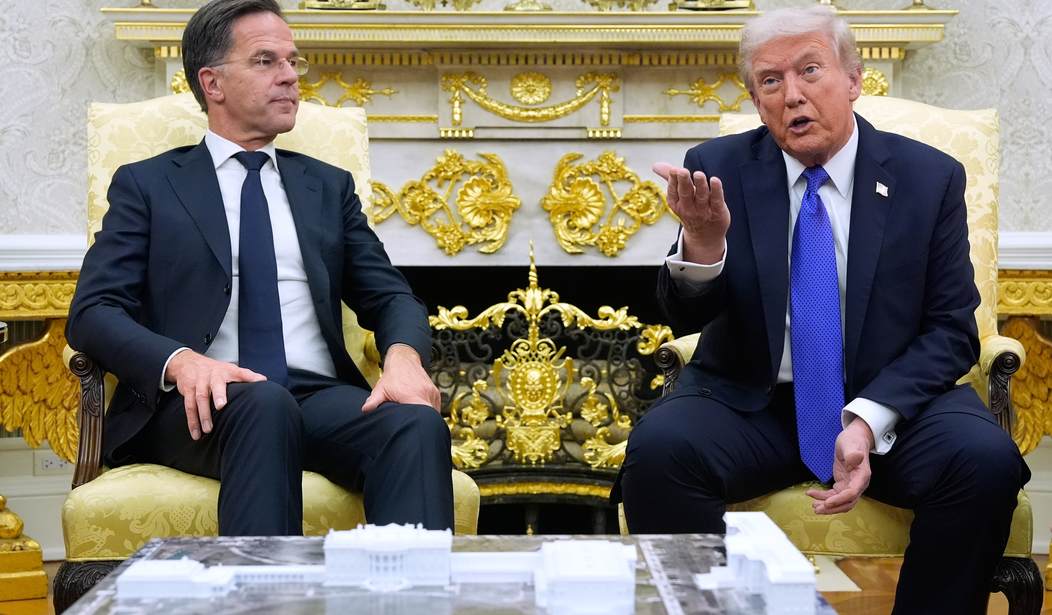
Perhaps it would be more of a fanciful thing, as matters stand at the moment. Or, more likely, another opportunity to recall Salena Zito's famous observation about Donald Trump.
ABC's Jonathan Karl spoke with Trump this morning about the Iranian regime's efforts to keep enforcing a "toll" for passage through the Strait of Hormuz. Trump dismissed it and suggested that he would consider making it into a "joint venture," even though the strait passage falls entirely within international waters:
This morning, I asked President Trump if he’s okay with the Iranians charging a toll for all ships that go through the Strait of Hormuz, he told me there may be a Joint US-Iran venture to charge tolls:
— Jonathan Karl (@jonkarl) April 8, 2026
“We’re thinking of doing it as a joint venture. It’s a way of securing it —…
“We’re thinking of doing it as a joint venture. It’s a way of securing it — also securing it from lots of other people.”
“It’s a beautiful thing”
The New York Post observes the obvious about this suggestion:
Just hours after the cease-fire began, Iran has already begun demanding tolls via crypto to pass safely through the strait. ...
The Strait of Hormuz, a narrow chokepoint between the Persian Gulf and the Gulf of Oman, is considered an international waterway. About a fifth of the world’s oil supply passes through it, making any policy shift there a matter of global consequence.
OKing a toll would mark a dramatic shift in US policy toward Iran and maritime security in the region. Historically, Washington has pushed for free and open navigation through the strait, backed by naval presence to deter threats and ensure the flow of goods.
These are not "tolls." They are extortion attempts, backed by the kind of force that the cease-fire was meant to preclude. Furthermore, the entire notion violates the United Nations Convention of the Law of the Sea (UNCLOS), which Iran's mullahcracy signed in 1982. (The US signed the agreement but has not ratified it as a treaty.) Under Part II, Section 3 of UNCLOS, all ships are entitled to "innocent passage" on international waters anywhere, including in the Strait of Hormuz.
In fact, charging "tolls" on shipping through recognized territorial waters is banned under UNCLOS under Article 26:
1. No charge may be levied upon foreign ships by reason only of their passage through the territorial sea.
2. Charges may be levied upon a foreign ship passing through the territorial sea as payment only for specific services rendered to the ship. These charges shall be levied without discrimination.
Besides, Iran isn't the only country with interests in the Strait. Oman, which has been friendlier to Tehran than most other Gulf states, put its foot down "firmly" over Iran's attempts to extort shippers for safe passage:
Oman has firmly opposed any proposal to levy tolls on ships passing through the Strait of Hormuz, pushing back against ideas reportedly being explored by Iran as part of broader ceasefire discussions in West Asia.
The resistance from Oman reflects the growing tensions over the future of one of the world's most critical oil chokepoints, even as diplomatic efforts continue to stabilise the region....
According to reports, Iran has floated the idea of charging vessels as part of potential ceasefire arrangements.
However, Oman — which shares control of the strait alongside Iran — has made it clear that any such toll regime would violate existing international agreements and set a risky precedent.
So, no, setting up the William J. LePetomane Thruway in the Strait of Hormuz – or anywhere else – would not be a "beautiful thing," regardless of how many s***loads of dimes we might collect:
So why did Trump suggest that he'd be willing to partner with Iran on tolls while speaking with Karl? Three possible reasons come to mind:
- Trump was being sarcastic
- Trump meant to be taken literally as to imposing fees for international shipping
- Trump wanted to be taken seriously in terms of flexibility in dealing with the 'new' regime in Tehran
Frankly, none of these makes this exchange defensible, but 1 and 3 come closer to that point. The second option would undo centuries of trade security and encourage every tinpot navy – especially China's – to exact "tolls" for passage. The first option doesn't exactly sound like Trump either, who's usually more inclined to insult reporters directly rather than use sarcasm in this manner.
That leaves the third option as the most likely, with Salena Zito's advice to take Trump seriously rather than literally. Trump invested himself in the risks of a cease-fire deal with the regime, at least to the extent that he'd rather give the IRGC some room to come to the table and negotiate rather than just reflexively return to hostilities. Trump has exhibited this trait consistently with the Iranians, and with the Venezuelans and Cubans to a lesser degree. He likes deals and likes to think outside of the box, and isn't shy (or careful) about spitballing in public to look reasonable. Trump's response to Karl's reasonable question fits Option 3 best.
That doesn't make it a good idea, though. It still remains a very bad idea, and if Iran continues to extort tankers passing through the Strait, Trump will need to deal with it harshly if he wants energy prices to return to normal. It's his cease-fire, after all, and it's on Trump to enforce it now.
Editor's Note: For decades, former presidents have been all talk and no action. Now, Donald Trump is eliminating the threat from Iran once and for all.
Help us report the truth about the Trump administration’s decisive actions to keep Americans safe and bring peace to the world. Join Hot Air VIP and use promo code FIGHT to get 60% off your membership!










Join the conversation as a VIP Member