This morning’s Gospel reading is Matthew 14:13–21:
When Jesus heard of the death of John the Baptist, he withdrew in a boat to a deserted place by himself. The crowds heard of this and followed him on foot from their towns. When he disembarked and saw the vast crowd, his heart was moved with pity for them, and he cured their sick. When it was evening, the disciples approached him and said, “This is a deserted place and it is already late; dismiss the crowds so that they can go to the villages and buy food for themselves.” Jesus said to them, “There is no need for them to go away; give them some food yourselves.” But they said to him, “Five loaves and two fish are all we have here.” Then he said, “Bring them here to me,” and he ordered the crowds to sit down on the grass. Taking the five loaves and the two fish, and looking up to heaven, he said the blessing, broke the loaves, and gave them to the disciples, who in turn gave them to the crowds. They all ate and were satisfied, and they picked up the fragments left over — twelve wicker baskets full. Those who ate were about five thousand men, not counting women and children.
Yesterday, our choir sang the hymn "Sacramentum Caritatis" at Mass, a particular favorite of mine, both for its harmonies and for its message. Songwriter Michael Joncas blended the old and the new into its structure, with a traditional refrain sung in Latin (although English translations are in the hymnal as an option). At the same time, he employed a more modern approach to the verses, lyrically and melodically. The effect is to marry the old tradition to a newer approach in liturgical music, and Joncas is talented enough to succeed.
Plus, I must admit, I am a sucker for a great baritone line, and this hymn delivers it in the refrain. We all have our biases, you know.
The refrain focuses on the sacrament of the Eucharist, which one might expect for a Catholic hymn with this title. Today, though, I want to focus more on the verses, which focus instead on how the Lord emptied Himself out for us in our need throughout salvation history, nourishing and sustaining us to remain on the path. The first verse recalls the manna and water in the desert while the Israelites spent 40 years on the way to the Promised Land. The second verse then speaks about the bounty the Lord provided the Israelites in the Promised Land. The third verse goes back farther in salvation history, as we sing about Melchizedek and his blessing of bread and wine. The fourth and fifth verses then tie these to the Eucharist.
This hymn walks us through salvation history, connecting the old to the new, just as we discussed in last week's reflection. We are called to do this not just because we get the Old and New Testaments in the same book binding, but because the Lord is constant in His love for us and in His mercy. Only our understanding and adherence to His will change in the ebbs and flows of our commitment to His will. The Word of the Lord remains constant as well, as does the Holy Spirit that invites us into communion with Him.
Communion is the meaning of this gospel reading from Matthew as well. Jesus comes to us as the Word Incarnate with two natures – one fully divine and the other fully human. We accept that as given in our age, but the early church struggled mightily with this mystery, and some heresies erupted in the failure to embrace it. Today's gospel is not the only example of this mystery, either, but it may be among the most significant.
First, Jesus is so moved at the death of His cousin and prophet that He needs to withdraw to contemplate it. Why? In His divine nature, Jesus would have known that John the Baptist would be killed, and even more, that He would follow not all that long afterward. Further, Jesus knew that He and John would be reunited in the eternal kingdom, and given that eternal nature, already had been reunited. Jesus' human nature mourns John's loss, however, and Jesus fully embraces the mourning that men and women experience at death. The same process happens with the death of Lazarus, as well as during the Passion, when Jesus mourns His own upcoming death and asks the Father if that cup could pass instead.
These are not contradictions to Jesus' divine nature, although they may seem to be. These are the result of the communion of the divine and the human, in which men and women enter the Trinitarian life. The Lord wants us to experience the full communion of eternal life as human beings, both spiritual and material. This is why the Lord repeatedly provides for His children in self-emptying love. The manna and water in the desert are poured out from the Lord. After Melchizedek blesses Abram with bread and wine, the Lord conducts the blood covenant with Abram (later Abraham), which puts all of the blood penalty on the Lord, and promises Abram that He will make him father of the nations.
The blood covenant itself is a communion between the Lord and Abraham, one in which the Father condescends to humanity by setting aside His omnipotence and binding Himself to us. We see Jesus in today's Gospel reading demonstrating the same kind of self-emptying love, which we call agape in the Greek and caritas in Latin. When Jesus withdraws, the crowds of people follow Him, hungering for the Word as well as for food. Even in His mourning, Jesus sees their needs and empties Himself out to meet them, in two distinct ways. First, Jesus miraculously multiplies the fishes and loaves to meet their physical needs, and then He speaks to the crowd to meet their spiritual needs, even while His own human nature mourns the murder of His cousin.
That is communion, the meeting of the human and divine in an embrace so perfect that no contradiction exists. This is the relationship the Lord seeks with us all, and seeks to model for us in our mission to convert the world. We must have that same, self-emptying love to model His Word and the same care for His children to succeed. Sacramentum caritatis, the purity of caritas love, is the thread throughout all of the scriptures, from Genesis to Revelation. The Lord continues to empty Himself to call us to eternal life in full communion with Him. Jesus Christ provides us with the New Adam, both fully human and fully divine, as a sign to demonstrate that life in full form, and by whom we may receive the grace to enter into it.
Previous reflections on these readings:
- A quiet moment, a miraculous feast: Sunday reflection (2020)
- Sunday reflection: Matthew 14:13–21 (2014)
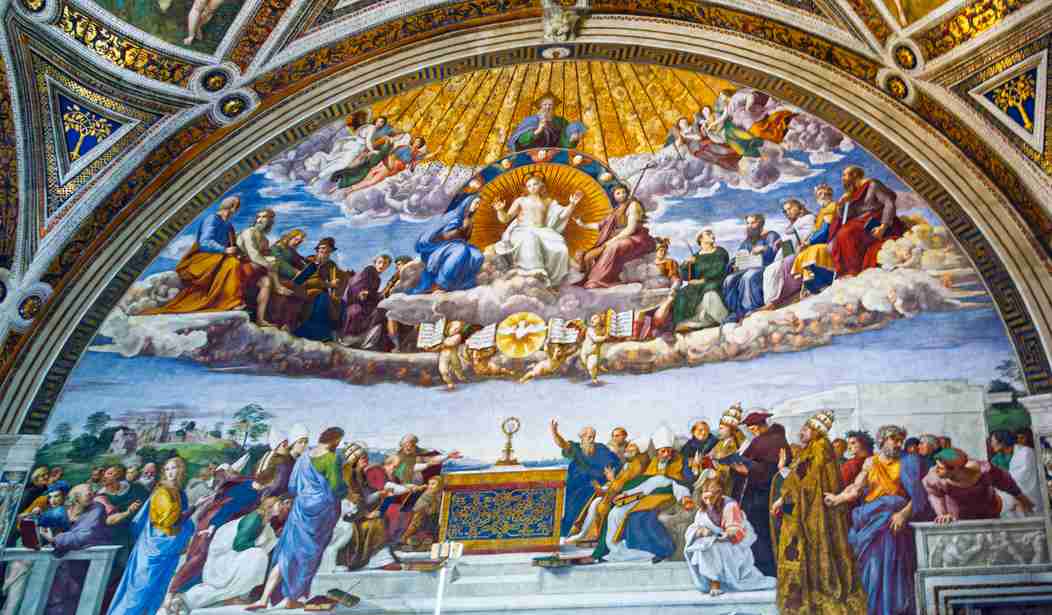
The front page image is "The Disputation of the Holy Sacrament" by Raphael, c. 1509-10. Fresco located in the Vatican Museum. From the personal collection of Ed Morrissey.
“Sunday Reflection” is a regular feature that looks at the specific readings used in today’s Mass in Catholic parishes around the world. The reflection represents only my own point of view, intended to help prepare myself for the Lord’s day and perhaps spark a meaningful discussion. Previous Sunday Reflections can be found here.
Editor's Note: Our Sunday Reflections are free to all readers, but our VIP members help keep this platform going for everyone. Join the effort by using the promo code FIGHT to get 60% off new memberships and upgrades to VIP Gold and VIP Platinum!











Join the conversation as a VIP Member