





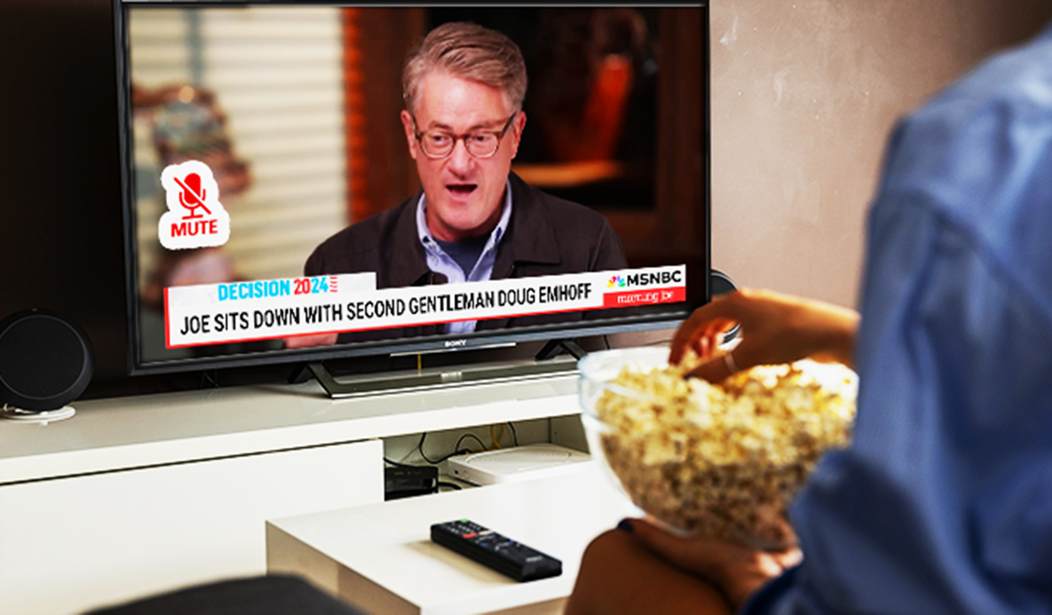
Has Donald Trump succeeded with his new "low-key" approach to the Hormuz crisis? Trump has managed to de-escalate hostilities. With M-SNOW, anyway.
Get ready for an avalanche of hate directed at Joe Scarborough for his sensible take this morning on the predicament Trump faces with Iran. He can't withdraw and let Iran seize international waters in the Persian Gulf. Trump doesn't have enough political support at home to put boots on the ground to seize key Iranian ports, especially Kharg Island. Our allies in the Gulf keep obstructing a return to full-scale "kinetic operations" out of concern for Iranian retaliation.
Trump's only option is to leave the IRGC on read for negotiations and to tighten the blockade. Scarborough assesses the situation rationally as it stands in the moment, and praises Trump for remaining "stubborn" rather than caving to the IRGC for a cheap way out of the situation:
I’ve got to say, again here we have the president, in a good way I think, being stubborn, not saying ‘Iran we’re going to give you whatever you want, we’re going to give you half $1 trillion, we’re going to have sanctions on your oil’ just do anything to get us out of this war. He’s tried that. The Iranians have proven they can’t be bribed.
And I do know gas prices are are high, they’re over $4. It’s interesting, though, because if you look at oil, oil prices, which a lot of people were predicting were going to be $150 a barrel, it’s like at $87, I think brent crude closed below $90 yesterday.
It's down even further this morning, dropping almost 3% for both overall crude and Brent crude. The overall prices are still higher than when the war started, but the lowering of the kinetic action in the region has confidence returning to the market about the future oil supply. That has helped keep inflation in check, or at least steady at mildly elevated levels. The Producer Price Index came in unchanged this morning, signaling some relief for consumers in the next few months, but not much hope that prices will decline significantly either. The CPI rate of inflation report this week also showed an essentially unchanged consumer landscape in July.
Trump could conceivably score a short-term win on inflation by declaring victory and departing the Strait of Hormuz. We don't rely on energy from that passage (although we do rely on it for fertilizer and some other goods), and the resulting sharp decline would help Republicans in the fall. Scarborough recognizes this and gives Trump credit for refusing to take a bad deal:
That’s showing something that I don’t know a lot of people in the hot heat of a political campaign will take note of. But that’s showing that America’s energy supplies are far more resilient.
And I will tell you, America’s long term strategic health, militarily and geopolitically, depends on the Strait becoming less and less relevant, which I think the longer this drags on, the less relevant it’s going to become.
So the president, of course, saying a lot of things that are going to provoke, but also, though it’s more of a head down approach, so-called ‘low key approach’, we’re going to take our time. We’re not going to be pushed into a deal that gives the worst regime in the world half $1 trillion.
That's a remarkably sane assessment, not just on M-SNOW, but also especially on M-SNOW. I'm not terribly surprised; Scarborough clearly detests Trump, but he's smart enough to recognize the contours and nuances of this standoff. I suspect his audience will be neither smart nor nuanced enough to appreciate that, which makes Scarborough even more gutsy for making this argument on air.
Will the "low-key" strategy succeed? It will take a lot of strategic patience from Trump and a denial of his innate impulse to cut a deal for the sake of a deal. However, it does appear to be working this week by one metric, which is that Iran's interlocutors in Qatar and Pakistan have stopped talking about deals on the horizon, at least for now. That suggests that the US has expressed disinterest in any proposal from the IRGC that doesn't involve a full return to the status quo ante in the Strait and concessions on nuclear weapons and terror proxies. The price of oil is still dropping without the rumors of a deal and without a full reopening of traffic through Hormuz, which indicates that investors see long-term oil supplies as stable even without a clear resolution of the Hormuz crisis.
In other words, Iran's leverage is slowly bleeding out, even if they don't yet recognize it, while the blockade starves them of everything else. Obstinacy has its time and place, and that's in the Strait of Hormuz now and in the foreseeable future ... hopefully.
Editor's Note: For decades, former presidents have been all talk and no action. Now, Donald Trump is eliminating the threat from Iran once and for all.
Help us report the truth about the Trump administration's decisive actions to keep Americans safe and bring peace to the world. Join HotAir VIP and use promo code FIGHT to get 60% off your VIP membership.


Join the Conversation
VIP members get the ability to comment on articles.