







What happens when you and your party spend tens of millions of dollars fighting in the primary? Especially when most of that money got spent fighting each other? The two winners this month in Michigan and Wisconsin are about to find out the answer.
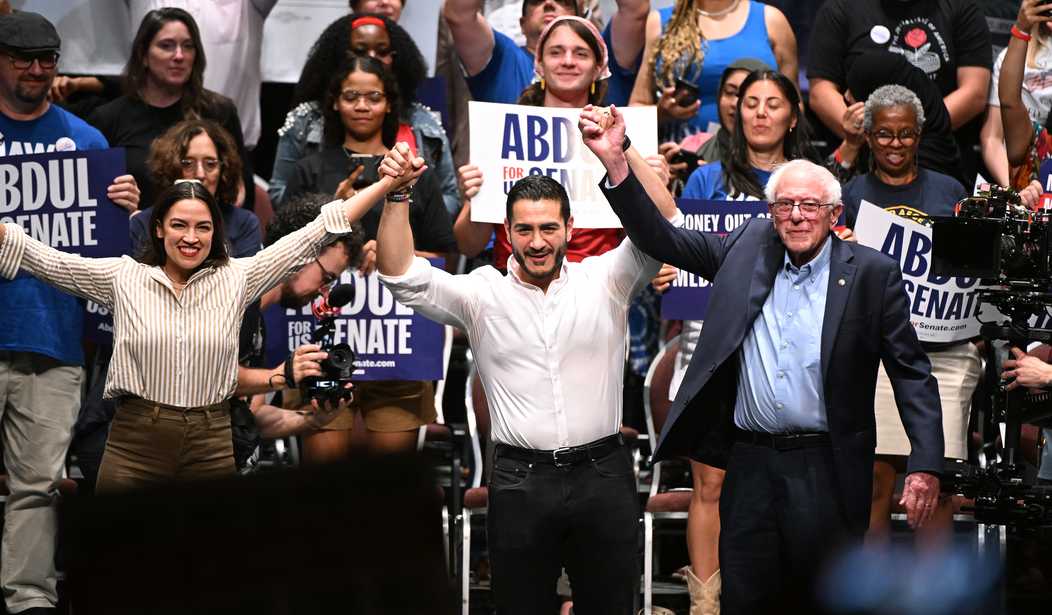
Semafor's Burgess Everett explains the crisis that Abdul El-Sayed faces after an embarrassingly narrow win over Haley Stevens nine days ago. El-Sayed has more problems than just trying to bully moderate Democrats into staying in line, a task which has apparently been outsourced to his buddy Hasan Piker. His campaign exhausted itself in the primary, while Republicans have raised money hand over fist.
Everett notes all of this and points to the one lifeline that El-Sayed might have:
The Senate Leadership Fund has $51 million invested in the Michigan race, AIPAC is expected to plow millions in to stop El-Sayed, and former Rep. Mike Rogers, the Republican nominee, is one of the GOP’s better fundraisers. The Democratic Senate Majority PAC is doing all it can to keep up, with $20 million in TV ads reserved and a substantial digital investment as well. Still, there’s no question that Democrats face a sizable money gap. ...
Bernie Sanders got his guy in Michigan, but he’s going to have to do more if he wants to successfully shepherd Abdul El-Sayed through the general election due to the huge spending disadvantage Democrats face.
Sanders has more than $22 million in his campaign account, and he didn’t rule out using some of that to help El-Sayed when asked if he’d considered transferring that money to the Democratic Senatorial Campaign Committee.
It's not just the money gap, either. It's also the gap between the radical DSA and DSA-aligned Marxist winning these nominations and the moderate-to-conservative electorates they have to convince. Donald Trump won Michigan two years ago by painting Kamala Harris as a radical socialist; no one has to work hard to make that case for El-Sayed, both culturally and politically. El-Sayed survived a big money gap in the Democrat primary, but that was among motivated Democrat voters, some of whom were motivated to stop him.
Now El-Sayed and Democrats have to overcome a money gap and a culture gap in the same electorate that rejected Harris. Will more money help with the more important gap? There's a good chance we'll never find out, at least if Bernie Sanders stays consistent. Everett edges around the real issue, which is that Sanders can't directly transfer that money to El-Sayed:
If Sanders were to transfer money to the DSCC, a recent Supreme Court ruling allows the party’s campaign to spend unlimited money in coordination with a candidate, and likely at more favorable rates than super PACs. El-Sayed was heavily outspent in the primary against Democratic Rep. Haley Stevens, D-Mich., but that could pale in comparison to what he’ll grapple with between now and November.
The decision in NRSC v FEC only controls for party organizations, not for outside orgs, other candidate campaigns, or PACs. Perhaps a later challenge will clarify whether the First Amendment issues also apply to those orgs, but for now, the DSCC would have to get the funds in order for it to be transferred to El-Sayed's campaign without limits.
And therein lies the problem for all sides. Would the DSCC transfer all of those funds as directed, however? Sanders isn't even technically a Democrat. He's also been responsible for pushing DSA and DSA-aligned Marxists into challenging Democrat incumbents. Sanders is a big reason why Democrats in Michigan face the prospect of throwing away a seat on a radical Islamist-linked Marxist that they could have held with a candidate more closely aligned to an electorate that voted for Trump two years ago. The DSCC likely has very little tolerance for Sanders these days, especially now that they have play cleanup in Michigan.
The same is true for Sanders as well. He just watched the Democrat establishment throw tens of millions of dollars to block his own endorsed candidate in the primary. Why would Sanders trust the DSCC to use his money in its entirety to promote El-Sayed? From Sanders' perspective, the money gap exists now because the Democrat establishment forced El-Sayed to burn all of his resources on the primary while Mike Rogers and the NRSC built a general-election juggernaut. There's no reason for him to trust that same establishment not to split the funds across several campaigns, perhaps especially those Senate races where the candidate's father-in-law has connections to the Muslim Brotherhood and operates a mysteriously-funded PAC that has floated El-Sayed this far.
Sanders might like the idea of redistributing the wealth, but he's not going to trust the Democrat establishment with the power to redistribute his wealth. Socialist cranks get mighty particular about whose hand is in the till.
The Democrats will shortly discover the same problem with David Crowley in Wisconsin. Having actually succeeded in intervening against the DSA candidate by defeating Francesca Hong, they now have a candidate who ran an inept primary campaign and no investment in the outcome from the DSA wing of the party, unlike in Michigan. Tom Tiffany, like Mike Rogers, has had months of an easy primary season to build his general-election campaign and to lock in the funds to run it. The history of "Dirt McGirk" makes for a target-rich environment, and Crowley's radical politics will prove an almost equally bad fit for the electorate in a statewide general election.
That won't make these walkover wins for Republicans. However, Democrats usually have large fundraising advantages in these contests, so this changes the dynamic. The only way to rectify that is to pull resources from other races, especially with the Democrat donor revolt taking place at the moment. Even Sanders' money may not make much of a difference in either state, which is another reason for Bernie to burn his cash elsewhere under his own control.