






This morning’s Gospel reading is Matthew 16:13–20:
Jesus went into the region of Caesarea Philippi and he asked his disciples, “Who do people say that the Son of Man is?” They replied, “Some say John the Baptist, others Elijah, still others Jeremiah or one of the prophets.” He said to them, “But who do you say that I am?” Simon Peter said in reply, “You are the Christ, the Son of the living God.” Jesus said to him in reply, “Blessed are you, Simon son of Jonah. For flesh and blood has not revealed this to you, but my heavenly Father. And so I say to you, you are Peter, and upon this rock I will build my church, and the gates of the netherworld shall not prevail against it. I will give you the keys to the kingdom of heaven. Whatever you bind on earth shall be bound in heaven; and whatever you loose on earth shall be loosed in heaven.” Then he strictly ordered his disciples to tell no one that he was the Christ.
All throughout salvation history, we are given a choice. Do we choose to listen to the Lord, our Creator and Father, and trust His will for our happiness in His plans? Or do we choose to go our own way in the creation He has given us, refusing to accept His authority in it, and choose to usurp it to pursue our own ambitions?
This is, unfortunately, not a trick question.
Both the Old and New Testaments provide plenty of evidence of choosing unwisely, from the first chapters of Genesis to Paul's epistles to his churches. The Davidic kingdom and its split successors eventually crumble and fall as a result of refusal to remain faithful to their purpose of converting the world to His Word. Individually, we fall short of salvation for the same reasons: worldly ambitions and appetites lure us into believing we are the masters of Creation rather than its tenants and stewards. The Lord wants us to choose Him from our own free will, the gift of creation He has trusted to us, but will not force Himself upon us – a point that subtly undergirds our Gospel reading today, too.
Before we get to that, let's take a look at the full context of our first reading from Isaiah 22, which is pointed enough to get the general gist:
Thus says the LORD to Shebna, master of the palace: “I will thrust you from your office and pull you down from your station. On that day I will summon my servant Eliakim, son of Hilkiah; I will clothe him with your robe, and gird him with your sash, and give over to him your authority. He shall be a father to the inhabitants of Jerusalem, and to the house of Judah. I will place the key of the House of David on Eliakim’s shoulder; when he opens, no one shall shut, when he shuts, no one shall open. I will fix him like a peg in a sure spot, to be a place of honor for his family.”
Shebna also comes up in Isaiah 15, with almost the exact same warning, as an object lesson to ambitious and self-seeking officials in the Lord's kingdom. This will likely sound akin to several humblings of the haughty in the scriptures of those who defied the Lord, and one can certainly accept this at face value. The message from this brief reading of Isaiah 22 teaches a lesson clearly enough; if you do not perform your duties with integrity and faith, the Lord will punish you.
The broader context in the entirety of chapter 22 takes this well beyond Shebna, however. In this prophecy, the Lord condemns Judah more generally for its faithlessness. Isaiah is warning that the Lord will soon "strip[] away the defenses of Judah" that the kings had strengthened by tearing down houses rather than returning to the Lord and doing His will. (Jeremiah will later warn the Judeans that the Lord will not spare Jerusalem simply on the basis of the Temple, either.) It is on that day of reckoning, Isaiah warns, that the Lord will replace the authority in Judah to those worthy enough to choose Him rather than themselves.
This is why the prophet's reference to Hilkiah matters. We learn about Hilkiah in 2 Kings and in both Chronicles, a prime minister to King Josiah of Judea. Josiah comes to the throne after the idol-worship and heresies of kings Manasseh and Amon, who chose worldly power over the Lord's service. Josiah was a more worthy king, but in 18 years had not yet rid Judah of the pollution of idol worship and other practices. In 2 Kings 22, it is Hilkiah who finds the Book of the Law and restores it to the kingdom of Judea by bringing it to Josiah, who then chooses to serve the Lord. The Lord responds by granting Josiah an honorable death and place with his fathers afterward, although he cannot escape the consequences of his own sins.
When the Lord gives this warning to Isaiah, the reference to the "son of Hilkiah" foreshadows what will happen in the New Testament. Hilkiah was the lawbringer who restored the word of the Lord as the authority over Judea, at least for a time, but the kingdom quickly reverted back to its sinful pursuits of worldly power. If the Israelites and Judeans will not abide by the Law even when re-presented to them, then the son of the lawgiver will be handed authority over the kingdom and the mission.
That context gives a deeper meaning to today's Gospel reading in two ways. First, Peter chooses Jesus and bows to His true authority and identity as the Son of God. Jesus is the Son of the Lawgiver, appointed as the eternal authority over the Lord's kingdom, the Christ who restores the path to salvation through His Church. Second, Jesus then appoints Peter as the kingdom's steward in this world, replacing the old kingdoms and the temple authorities that succeeded them, just as Isaiah warned Shebna that the Lord would thrust him from his office.
In this action, Jesus appoints Peter to be the "son" of the Lawbringer, or more directly, His earthly successor within the structure of an eternal kingdom. This matches the language in both Isaiah 15 and 22 that warns that the son of the lawbringer will be clothed with the robe and sash of Shebna's office and granted his authority over the affairs of the kingdom. Both Isaiah and Jesus make specific reference to the "keys" of this kingdom, the sign of ultimate authority for a steward, a position of trust and faith.
Peter's faith and openness of heart allow him to choose Christ and trust Him over his own ambitions and understanding. It is that choice that allows him to be granted this authority. Peter would be tested and fail in this during the Passion, the risen Christ would restore him and reaffirm this appointment shortly before His ascension. This parallels the story of King Josiah after Hilkiah restores the Book of the Law to Judah; the Lord forgives Josiah his sins and brings him to his fathers in the eternal kingdom after Josiah repents and atones.
So it will be for all of us. We choose to live in Christ, but we stumble, fall, and fail along the way. As long as we return in penitence and atonement, Christ gives us the grace to return to the path of salvation through His Church. We must first choose to give the Lord authority and trust in His love for us, and when we do, the keys will open our path to eternal joy.
Previous reflections on these readings:
- The keyholders to the kingdom: Sunday reflection (2023)
- Who do we say we are? Sunday reflection (2017)
- Sunday reflection: Matthew 16:13–20 (2014)
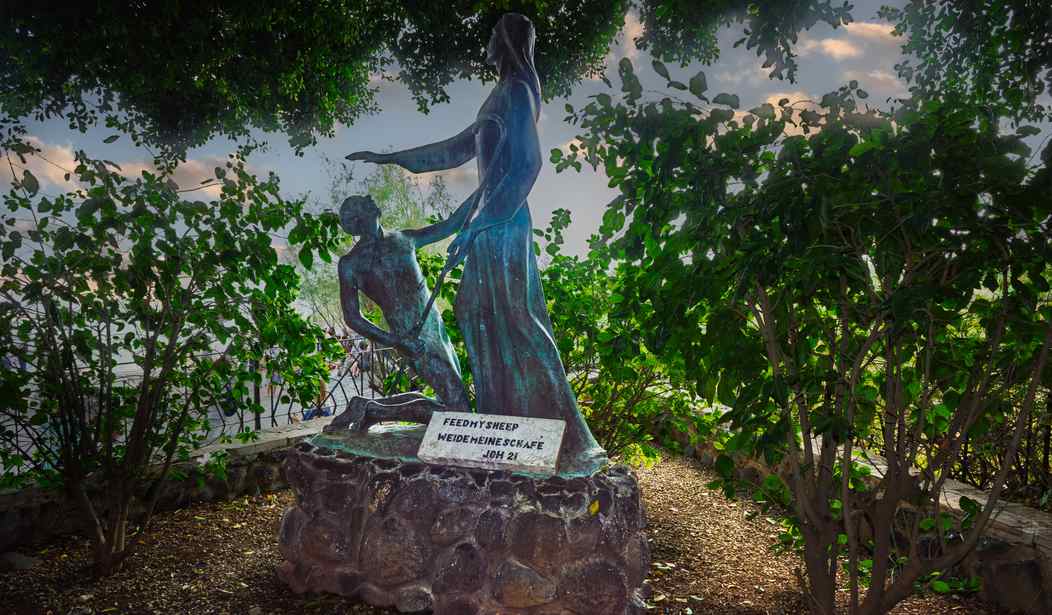
The front page image is the Feed My Sheep monument at the Church of the Primacy of St. Peter, Tabgha, Israel. Taken by Ed Morrissey in 2013.
“Sunday Reflection” is a regular feature that looks at the specific readings used in today’s Mass in Catholic parishes around the world. The reflection represents only my own point of view, intended to help prepare myself for the Lord’s day and perhaps spark a meaningful discussion. Previous Sunday Reflections can be found here.
Editor's Note: Our Sunday Reflections are free to all readers, but our VIP members help keep this platform going for everyone. Join the effort by using the promo code FIGHT to get 60% off new memberships and upgrades to VIP Gold and VIP Platinum!

Join the Conversation
VIP members get the ability to comment on articles.