
What kind of country do you want?
This is not a rhetorical question – not in 2026, not as the starkest choice we have faced in generations presents two very different visions of America. For most of my life, elections gave us a choice between policy approaches that differed in the ways to improve our path to ordered liberty and prosperity. Conservatives had a focus on economic liberty and disciplined social mores; Democrats proposed freer social policies and a more communitarian approach. Both parties still shared a similar vision of protecting and preserving the constitutional order, accepted a vision of the United States as a guarantor of individual liberty, and worked to preserve the institutions of a functioning republic that kept government power in check.
In those days, one could justify a lack of engagement. Some people complained, even back then, that the two-party system often felt more like a Uniparty with various factions competing over narrow differences. If that seemed true at the time, it reflected the shared general vision of America, aspirational in part and accomplished in larger part, based on our common civic values.
Those days have vanished. What has replaced them is a fracture worse than anything seen in several decades, where the two parties differ to their core about America and its future. One party wants to preserve the previously shared vision of America as a fundamentally virtuous actor in world history, leading humanity to liberty and prosperity while correcting its flaws and errors along the way. The other party wants to fundamentally transform the country along a Marxist model that surrenders power to the government, dismantles the institutions that preserve liberty and stability, and dismantles the nuclear family, private property, and the individual conscience to an elite cult.
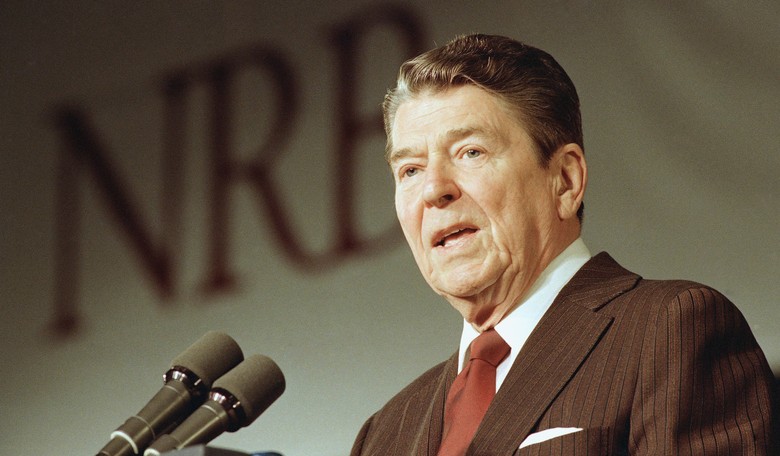
As Ronald Reagan put it, we face a real time for choosing – and this time, sitting it out means allowing the Marxist radicals to take power away from us all.
In some specific elections, conservatives complain that they don't have a stake in the choices. That misses the reality of the moment, as Josh Hammer wrote last week for Front Page Magazine. Even if a conservative sees mediocrity in the specific ballot choice, the larger issue of policy direction remains and must take priority:
To be a realist in American politics is to accept that we live, and have lived since the founding of the modern Republican Party in the mid-1850s, in a two-party system. When we vote in any given state or federal election, it is simply the case that either the Republican or Democratic candidate for office will prevail. We can wish it were not so, and that were viable third-party options, but to wish for a “better” or “ideal” world is to commit the fundamental error of not living in reality. The only relevant question at this time, when an American enters the voting booth to elect someone for state or federal office, is whether the Republican or the Democrat will win.
That is not a simplistic or reductionist view of voting: It is merely a description of reality. ...
But still, the Republican Party is a basically pro-American, pro-Western civilization political vehicle. The same cannot be said for the modern Democratic Party, which has been overtaken by its radical elements and is now the de facto party of the “Red-Green” Marxist-Islamist Alliance. Democrats are the party of China, Russia, Iran, Qatar, the Brotherhood, Marxism, and Third World-ism, more generally. Democrats, in short, are the party of barbarism. They represent a radical, un-American force operating in parasitic fashion within American politics, and their continued success can only herald very, very bad things for the future of the republic. The Republicans are very far from perfect, but they are certainly a heck of a lot better than that.
If being a conservative in the year 2026 means anything, it entails recognizing the fundamental divide between civilization and barbarism—and voting accordingly.
The reality in 2026 is that radicals have taken charge of the Democrat Party, which requires a rethinking of conservatism. It is not, and cannot be, merely a question of tax cuts and regulatory reductions. Conservatism is designed to conserve liberty and the institutions that protect it. This election features one party that pledges to advance that core agenda, and a party whose nominees want to revamp the Supreme Court, eliminate the Senate, and reduce the executive branch to a subordinate function of the House of Representatives – not to mention align with Islamists abroad and reopen the borders here.
This goes beyond candidate quality, as Angela Paxton selflessly declared last month. Voters have to stop focusing on tastes and start focusing on outcomes:
#TXPol: "I'm Texas Senator Angela Paxton. People have asked my thoughts about this election and turns out, I have some ... I'm voting for the Republican ticket on November 3rd." Texas PAC is up with a new ad featuring Angela Paxton, Ken Paxton's estranged wife. https://t.co/U7yYZ6ZBXp
— AdImpact Politics (@AdImpact_Pol) October 3, 2026
Your tastes are not more important than your country.
Your policy disagreements with Republicans are not more important than the Constitution.
Your wish for a different candidate cannot blind you to the consequences of allowing radicals to take power.
Your ennui will not justify your abandonment of your civic duty to preserve the nation and to turn back the radical and malignant ideologies that threaten to destroy it.
This is the time for choosing. This is the time to show up and be counted.
What kind of country do you want? Fight for it, and fight for it tomorrow at the ballot box, while you still can.