
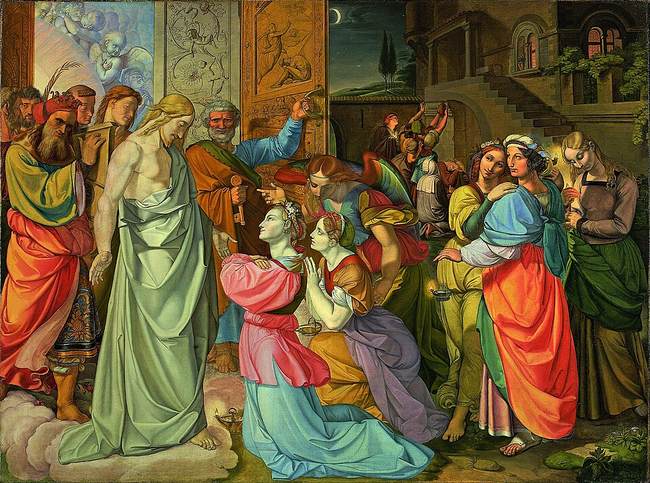
This morning’s Gospel reading is Matthew 25:1-13:
Jesus told his disciples this parable:
“The kingdom of heaven will be like ten virgins who took their lamps and went out to meet the bridegroom. Five of them were foolish and five were wise. The foolish ones, when taking their lamps, brought no oil with them, but the wise brought flasks of oil with their lamps. Since the bridegroom was long delayed, they all became drowsy and fell asleep.
At midnight, there was a cry, ‘Behold, the bridegroom! Come out to meet him!’ Then all those virgins got up and trimmed their lamps. The foolish ones said to the wise, ‘Give us some of your oil, for our lamps are going out.’ But the wise ones replied, ‘No, for there may not be enough for us and you. Go instead to the merchants and buy some for yourselves.’ While they went off to buy it, the bridegroom came and those who were ready went into the wedding feast with him. Then the door was locked. Afterwards the other virgins came and said, ‘Lord, Lord, open the door for us!’ But he said in reply, ‘Amen, I say to you, I do not know you.’ Therefore, stay awake, for you know neither the day nor the hour.”
For you know neither the day nor the hour. These words are at once both prosaic and prophetic. Prosaic, because we ourselves know that we do not know the Lord's plan or design. Prophetic, because despite this knowledge, we continue to act as though we do.
This is original sin: the constant attempts to force the Lord to our will rather than form ours to His. On that path lies wisdom, and the other folly.
That takes us to our first reading today from Wisdom, the book of advice on how to form ourselves to receive wisdom from the Lord. The writer casts Wisdom as feminine, a gracious presence who responds to those prepared to receive her but never imposing herself on those who do not want her. The language is poetic and stylistically romantic, but the love here is not eros but philia in nature:
Wisdom is radiant and doesn’t fade away; and is easily seen by those who love her, and found by those who seek her. She anticipates those who desire her, making herself known. He who rises up early to seek her won’t have difficulty, for he will find her sitting at his gates. For to think upon her is perfection of understanding, and he who watches for her will quickly be free from care; because she herself goes around, seeking those who are worthy of her, and in their paths she appears to them graciously, and in every purpose she meets them.
The writer of Wisdom offers this as an analogy to the Lord and His wisdom, always present in the scriptures and the Holy Spirit. The Lord does not impose Himself on those who do not seek or desire Him, but rather waits patiently for those who love or seek Him. The prophet promises that those who do welcome His wisdom will be "free from care," not in the worldly sense – even the most devout have cares in life – but free from the anxiety of separation from the Lord and secure in His eternal love. For the wise, this is sufficient, even while all of the cares and responsibilities of the world remain.
When we remain in the wisdom of the Lord, we do not need to know the day and the hour. We have already surrendered lordship to Him, forming our wills and desires to His will and desire for us. To put it in the sense of Jesus' parable, we have already married ourselves to the bridegroom. We do not have to worry about His arrival; it has become a mere formality while we prepare ourselves for it.
In that wisdom, we remain radiant and become an instrument for His wisdom and radiance as well.
The parable itself makes clear the folly of attempting to prognosticate the moment of truth, either in the historical or personal sense. The moment when we as individuals go to Christ cannot possibly be predicted with accuracy, nor can the moment when Christ returns at the end of the world to finally reconcile all within it. The wise virgins therefore prepare themselves first and live their lives in anticipation of the wedding; the foolish virgins postpone that preparation, only to be caught by surprise and get left out.
That part of the parable is very clear: be prepared. If we know not the day nor the hour, then it is wise to act as though each day and hour might be the time Jesus calls us to the feast. Those who open their hearts to this truth will receive Wisdom, also known as the Holy Spirit, and in every purpose of our formation the Paraclete will meet us.
This parable speaks to another point, however: arrogance. We have an innate sense of revulsion at the foolish virgins who refuse to prepare themselves. Their arrogance offends us, because we recognize that they have rejected the proper order. And we know, as Jesus pointedly includes in this parable, that they will demand that others surrender their own prepared goods to rescue them, which is yet another form of arrogance. The arrogance of original sin stains not just our relationship with the Lord but with each other as well, and these foolish virgins want to claim ownership of what is not theirs to achieve that for which they refused to prepare.
If wisdom is radiant, then arrogance is a dark shadow on all relationships. The lamps in this parable underscore this point. The wise virgins prepared themselves by buying oil so that their light would never dim. The foolish virgins never bothered to get oil and had to live in the darkness. Jesus' point is not subtle; we must prepare ourselves for the Light of Wisdom and the Trinitarian life. Failure to prepare for the wedding feast means being left in the darkness.
The wedding imagery is also no accident. In Revelation, John offers us the vision of the Church Triumphant in which the Lamb of God's wedding feast brings all those who chose Him into the divine Trinitarian life for all eternity. The Mass on Sunday offers us a glimpse of that wedding feast and forms us to it, connecting us to the one true sacrifice outside of space and time. We are there to worship, and in the sense of this parable, to fill our lamps so that we may enter into this eternal wedding feast in the Light and Wisdom of the Lord.
Some people put off that formation. I certainly did for several years, and even after returning to the Church, treated it as a burden rather than an act of love. Even today, that struggle remains as my mind wanders during the Mass and I attend with less grace than that to which I am called. The Holy Spirit remains nonetheless, radiant as ever, waiting patiently for me to love and seek the Lord with my full heart and to accompany me on my paths to Christ.
Previous reflections on these readings:
The front page image is "The Parable of Wise and Foolish Virgins (unfinished)" by Peter von Cornelius, c.1813-16. On display at the Museum Kunstpalast. Via Wikimedia Commons.
“Sunday Reflection” is a regular feature that looks at the specific readings used in today’s Mass in Catholic parishes around the world. The reflection represents only my own point of view, intended to help prepare myself for the Lord’s day and perhaps spark a meaningful discussion. Previous Sunday Reflections can be found here.