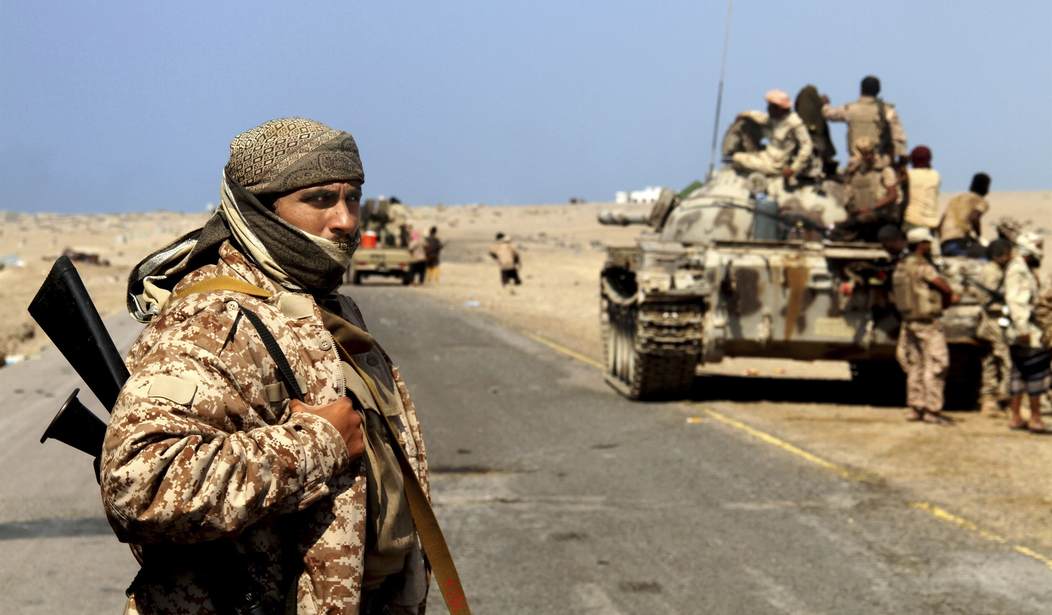
The Houthis had a terrible, horrible, no good, very bad day on Monday, and I'm here for it.
Yesterday, we posted a very long recap of last week's events in what is currently the most dynamic and fluid phase of the ongoing war against the Islamic Republic of Iran. It reads like a movie script, with Yemen government forces and allies whittling away at Houthi terrorist strongholds, only to have those gains lost in a day. But instead of giving up (and in) to the Houthis, the Yemen-Saudi-Giant Brigade forces dug deep, regrouped, and pushed back hard.
The bad news about the Taiz setback was that the mountainous high ground would remain contested for a while longer. The good news is while the Houthis were concentrating efforts there, the Yemenis were calling in their version of NATO's Article 5 in the Mecca Joint Defense Agreement, and that call has been answered by both Pakistan and Turkey.
On September 10, Yemen, the Giant Brigades, and the Saudis seemingly had Houthi forces surrounded in the No Man's Land highlands plateau of Central Yemen. The ring of containment was in place...until the Saudi line to the southwest collapsed, allowing the Houthis a corridor through the Taiz mountain pass and down to the Red Sea Coast. Because virtually all of Yemen's military efforts were focused on the middle of the country, the Houthis exploited that gap and took control of the strategic city of Mokha, complete with an airport, virtually all of the coastal strip, and of a couple islands in the al-Mandab Strait. The price of oil the day before the Red Sea Coast fell was around $95 a barrel, but it spiked to $108 over fears that the second most strategic chokepoint in the region was now threatened by Iranian-backed terrorists.
Flash forward to yesterday. Once again, the region around Taiz remained the key ground to take and hold by both Yemen government forces as well as the Houthis. If the former controls that ground, Houthis on the coast to the west would have a hard time holding the Strait over time. If the latter controls it, supply roads to Yemen's back-up capital city of Aden to the south would be cut off. The Houthis sent everything from all directions to Taiz, which left the pro-Yemen alliance an opening to do to the Houthis what was done to them a month ago. Operation Dawn of Yemen commenced in the early morning hours, and instead of dawn rising in the east, it rose, in this case, in the west.
From @PresidentRashad With God’s blessing, Operation “Dawn of Yemen” has begun to restore state institutions, liberate the capital, Sana’a, and end the coup by the Houthi terrorist militia. With God’s help, the will of our people, the courage of our armed forces and all military formations, and the support of our brothers and friends, Yemen will move toward a new dawn of freedom, peace and stability.
— Basha باشا (@BashaReport) October 5, 2026
Over a hundred Saudi aircraft and thousands of ground forces swarmed the Red Sea coast in an all-out blitz, and within a few hours, hundreds of Houthis were dead where they fell, and those who weren't killed either surrendered or ran away.
Saudi-backed Yemeni forces said Monday they had retaken Mokha and advanced around the strategic Bab al-Mandeb Strait, one day after launching a major offensive to recover territory seized by the Iran-backed Houthis last month. https://t.co/9fy14VSnXr https://t.co/JtccD5nK0G
— Iran International English (@IranIntl_En) October 5, 2026
The images and videos coming out of the region are nothing short of extraordinary.
Footage shows strikes targeting Houthi fighters and military equipment as part of Operation “#Yemen Dawn," according to Yemeni military spokesman. https://t.co/nv6SpNCwQR
— Ali Al-Sakani | علي السكني (@Alsakaniali) October 5, 2026
In the mountains, there are plenty of places to hide. On flat sand near the water, there's nowhere a Toyota pickup can hide from an angry Saudi fighter pilot.
18-year-old Houthi fighter from Saada was also among those captured on the Bab al-Mandab front today. #Yemen https://t.co/BObeWzvL3o
— Ali Al-Sakani | علي السكني (@Alsakaniali) October 5, 2026
Many of those Houthi fighters that threw their weapons down and surrendered were just kids. They really didn't want to be there in the first place.
Houthi fighters surrendered on one of #Taiz’s frontlines today, with some appear to be children. #Yemen https://t.co/fByGigpJXq
— Ali Al-Sakani | علي السكني (@Alsakaniali) October 5, 2026
Scenes like this were everywhere after the shooting was over.
Dozens of Houthi fighters were captured today during fighting on the Bab al-Mandab front. #Yemen https://t.co/4f9kZPYor3
— Ali Al-Sakani | علي السكني (@Alsakaniali) October 5, 2026
The Houthis out of Sana'a said the pro-Yemen victory was fake news, but they could not offer up any evidence backing their claim. Conversely, dozens of videos like this were posted by pro-government forces. It looked like a rout.
Hundreds of Houthi fighters were killed, injured and captured on the Bab Al-Mandab front today. #Yemen https://t.co/ISdkUHmFGA
— Ali Al-Sakani | علي السكني (@Alsakaniali) October 5, 2026
24 hours ago, this was the gate to a Houthi military camp right next to the mouth of the al-Mandab Strait. Today? It's been liberated.
Pro-govt forces have retaken Al-Omari military camp in Dhubab from the Iran-backed Houthis. #Yemen https://t.co/2HhUK4tLWG
— Ali Al-Sakani | علي السكني (@Alsakaniali) October 5, 2026
More video of captured Houthi fighters.
Houthi vehicles were seized by pro-govt forces in Dhubab district today. #Yemen https://t.co/PGkZRPpek5
— Ali Al-Sakani | علي السكني (@Alsakaniali) October 5, 2026
Dhubab Airport next to the Strait is no longer under Houthi control.
Dhubab airport now recaptured by pro-govt forces in Dhubab district overlooking Bab Al-Mandab strait. #Yemen https://t.co/t7PrxMkuG5
— Ali Al-Sakani | علي السكني (@Alsakaniali) October 5, 2026
I'm old enough to remember when General Tommy Franks at CENTCOM directed the march across Iraq to take Baghdad in 2003. Once coalition forces were on the move from Kuwait, they mowed down anything in their path until they reached the ancient city. Monday's imagery, while nowhere near comparable in scope and land mass covered, resembled that same open backfield of 2003. The Houthis made the same mistake they exploited last month by not reinforcing the coast, thinking the smarter move was to concentrate on the mountains around Taiz.
#BREAKING: The pro-govt Southern Giants Brigades announce a “decisive” military operation against Houthi forces in Bab al-Mandab. https://t.co/dzgXC3VI8V
— Ali Al-Sakani | علي السكني (@Alsakaniali) October 5, 2026
This account says the Houthis are almost done. I think Monday was a very big step in that direction, but Yemen isn't completely out of the woods. Monday was a very good day, because several hundred fewer Houthi terrorists did not survive it. But Taiz has to be taken and held, and then the final battle for Sana'a looms.
🚨 The Houthis are almost done. Yemen’s government says it has taken the Bab al Mandeb coast and Dhubab including the airport and cut the road to Mokha. Saudi led coalition: 100 fighter jets in “Operation Dawn of Yemen” Air cover over the strait, around the clock 324 Houthi targets hit PLC chief al Alimi: restore the state. Retake Sanaa. End the coup. Their Red Sea chokehold is breaking. The strait moves about 12% of global trade.
— Martin (@Martin_Sedi) October 5, 2026
Just under a month ago, we saw images of Houthis in trucks with their rifles pointed skyward going down this same airport runway in celebration. It's now a complete role reversal, and with that, a significantly-reduced threat to shipping traffic through the al-Mandab Strait.
"Takeoff to Sanaa Airport will now commence from Dhubab Military Airport. Shift gears, it's lift off". A little war humor from the frontlines! After fierce clashes to secure Dhubab military airport, Southern forces take a victory lap down the newly liberated runway, pretending their car is an air plane. The morale of these men is absolutely unmatched. @alamalikah #SouthYemen #Yemen #SouthernGiants #قوات_العمالقة_الجنوبية
— Summer Ahmed سمر احمد (@summerahmeda) October 5, 2026
More kids forced to play soldier that were spared by pro-government forces.
A child soldier fighting for the Houthis was also among those captured at Bab al-Mandab today. #Yemen https://t.co/0J87J3bWQ6
— Ali Al-Sakani | علي السكني (@Alsakaniali) October 5, 2026
After capturing and holding the southern part of the Red Sea Coast, the drive north to liberate Mokha was next.
War in #Yemen #SITREP | 7 PM local time | Government-backed @alamalikah and @diralwatan forces have reached Mocha District and secured the highway running from Bab al-Mandab through Dhubab to the Mocha junction. Forces are now preparing to push toward Mocha city and recapture its airport and seaport. There are still pockets of Houthi forces in the area, and fighting is not over. But this is already a major victory for the anti-Houthi coalition and a significant reversal of the Houthi gains along Yemen’s southern Red Sea coast. Easy come, easy go.
— Basha باشا (@BashaReport) October 5, 2026
When government forces got there, it was the same result. Houthis that weren't killed either made a run for it or simply gave up.
Houthis are fleeing their positions on the coast https://t.co/dyXhOvyaIv
— Zineb Riboua (@zriboua) October 5, 2026
If a Houthi pointed a rifle, they were shot dead, run over, or blown up. If they gave up, they were treated humanely.
بالتفاصيل والتوضيح هؤلاء لم يكونوا أسرى ولم يسلموا أنفسهم ويلقوا السلاح ، هؤلاء كانوا مسلحين وبنادقهم تصوب نحو طقوم العمالقة الجنوبية هذا فيديو توضيح لما حصل ، وهناك الكثير من الاسرى رموا السلاح وتم معاملتهم معاملة أخوه ولهم الحق الكامل بمعاملة اسرى الحرب https://t.co/ZV6fMonT7n
— Ahmed Al-Ashwal (@alashwaly1) October 5, 2026
Another kid. This one is around 14 years old, and he most certainly did not want to die today.
Yemeni forces took as POW this 14-year old boy fighting with the pro-Iranian Houthi militia. In Gaza, Hamas and Islamic Jihad also deployed child soldiers. If you're wondering why, it's because Islamism considers adulthood to begin at puberty. When they are killed in battle, HRW and Amnesty will raise hell over armies killing babies. In America, this boy would have been playing sports and preparing for Halloween and HoCo.
— Hussain Abdul-Hussain (@hahussain) October 5, 2026
And another.
Today in Mokha: Government soldier: How old are you? Houthi fighter: 13… 14… uh… 19. Soldiers: Where are you from? Houthi fighter: I’m from Al-Haymah, Sana’a. Soldiers: Why are you here? Why did the Houthis send you to fight? Houthi fighter: Please, don’t do anything to me. Soldiers: don’t worry. I swear to God, nothing is going to happen to you. No one will touch even a hair on your head. You are under our protection now.
— Khatab Alrawhani (@alkhatabyemen) October 5, 2026
This is the vaunted Houthi militia — kids with guns and adults high as a kite on khat. Keep this in mind when you're thinking about what remains in Iran with IRGC and Basij forces. They've had so many desertions and suicides, they've resorted to conscripting boys to run checkpoints with guns. Women in burqas are being quickly armed and trained to do basic sentry. Mind you, no one's getting paid. Their hearts cannot truly be in this fight to save the dying regime.
Now for the fun part. Monday's action was not relegated solely to the southern Red Sea Coast. Yesterday, my column mentioned the Houthis' desire to cut off Aden's supply line to the south. But Yemen government forces also had a supply line of their own they wanted to take out feeding the Houthis entrenched in the capital city of Sana'a. And that line runs to west to the Red Sea coastal port city of Hodeidah.
#BREAKING: The Saudi-led coalition says a naval operation in Hodeidah governorate destroyed Houthi arms stockpiles and storage facilities containing explosive-laden boats and naval mines. The coalition described the sites as legitimate military targets and said the operation supported its efforts to protect shipping through the Bab al-Mandab Strait. #Yemen
— Ali Al-Sakani | علي السكني (@Alsakaniali) October 5, 2026
Weapons depots, explosive boat storage facilities, and naval mines belonging to the Houthis were hit in Yemen's Hodeidah Governorate by naval forces of the Saudi-led coalition. Coalition spokesman Turki al-Maliki: "We thwarted a plot for imminent attacks targeting the waterways south of the Red Sea. The operation is within the objectives of the Coalition to protect maritime navigation security in the Bab al-Mandab Strait."
— Open Source Intel (@Osint613) October 5, 2026
The route to the sea and the primary seaport for the Houthis is now contested, and Houthi assets are systematically being destroyed. This is a big reason why Brent crude prices just fell below $100 a barrel again. If Yemen holds the Red Sea coast and threats to shipping out of Hodeidah are neutralized, oil will move more freely to Asia through the Strait.
To their north above Sana'a in Marib, Operation Dawn of Yemen paid a visit as well.
The Yemeni National army has advanced south of #Marib against the Iran-backed Houthis, capturing Al-Faliha area. Fighting remains ongoing. #Yemen https://t.co/AAGQt2ZHE9
— Ali Al-Sakani | علي السكني (@Alsakaniali) October 5, 2026
Once Marib to the northeast is cleared, it's another open backfield south to Sana'a.
Yemen ordusuna ait konvoy.. Marib hattında Toplanıyor.. Hedefleri Başket Sanaa https://t.co/tpAoXtaORo
— ASB (@h_useyin987) October 5, 2026
And this is before Turkey and Pakistan have fully deployed their troops, which is underway.
BREAKING: The Mecca Joint Defence Agreement committee agreed to immediately implement collective defence commitments, including providing agreed military forces and capabilities for rapid deployment in Saudi Arabia, according to a joint statement. https://t.co/E3lk4CpsFx
— Faytuks Network (@FaytuksNetwork) October 5, 2026
In yesterday's column, I told you to keep your eyes on Taiz, because control over that would determine whether the Houthis live on for a while, or whether Sana'a was encircled and eventually engaged on all sides. After the Houthis that could flee the coast fled to the hills, that's when their bad day really kicked into gear. Ambushes were waiting for them everywhere.
Two Houthi vehicles were ambushed and destroyed in #Taiz today. #Yemen https://t.co/LG0HAu3xG7
— Ali Al-Sakani | علي السكني (@Alsakaniali) October 5, 2026
#Taiz Military Axis says a drone strike hit a Houthi pickup carrying a 23mm gun and fighters on Taiz’s western front, setting it on fire and leaving those aboard dead or wounded. #Yemen https://t.co/MF4kJp2hrO
— Yemen Newsroom (@yemen_newsroom) October 5, 2026
There's still a lot of work to do in very rugged terrain, but right now, the Houthis are getting the worst of it.
Morale is rising among local residents in Jabal Habashi District, rural Taiz, following the launch of the West Coast operation. Local fighters have once again begun ambushing Houthi forces in the area. https://t.co/vaxDH7pnZa
— Basha باشا (@BashaReport) October 5, 2026
There were some reports that the mountains weren't safe, either, and several Houthi units bugged out of there as well.
A number of Houthi technicals filmed “redeploying” out of rural areas in Taiz
— Basha باشا (@BashaReport) October 5, 2026
For other Houthis running into Taiz from the coast, they were disoriented by the chaos of the day and relied on locals to help them navigate the terrain. Naturally, the locals sent them the wrong way, and on top of being caught in ambushes, they got hopelessly lost.
⭕دخل الحوثيون مناطق وقرى وجبال تعز مستعينين بمتحوثين محليين رخاص .. فلما حان وقت الانسحاب والفرار، تاهوا ولم يجدوا من يدلهم على طريق النجاة.. لأن المتحوثين كانوا أول من فرّ وتركهم لمصيرهم... https://t.co/iLUFa2cBWg
— عبدالرقيب الهدياني Raqeeb Al-hdiani (@alrkeb) October 5, 2026
From another account translated from Arabic.
Confusion among Houthi fighters coming from outside #Taiz in the province's countryside:
▪️A citizen in Jabal Habashi: There is currently a small lost Houthi group in the village of "Dhi al-Shahran" in the Nemra district, searching for help to find their way out.
▪️A citizen in Al-Ma'afir: I met a Houthi military squad in the "Ras al-Naqil" area near Al-Alum; they have lost communication with their comrades.. He asked me: What is the name of this area and where does this road lead?
*Fares al-Humairi
Other Houthi fighters around Taiz tried to plant a bunch of mines to slow down advancing Yemeni and Giant Brigade forces. The problem was they were coming too fast and they had to leave everything behind and run away before being overrun.
These newly made mines were left behind by fleeing Houthi fighters who had no time to plant them in villages in #Taiz today. #Yemen https://t.co/pBHWHAzKLQ
— Ali Al-Sakani | علي السكني (@Alsakaniali) October 5, 2026
If you want an A/B to see how good of a day the Houthis had, what better way than to hear from the Houthis themselves? This is Mohammed al-Bukhaiti, a current member of the Houthi political bureau. A week ago, his rhetoric was all fire and brimstone. If the Mecca pact were invoked and Pakistan and/or Turkey got involved, he warned, "We will strike with an iron fist." The bravado then was positively IRGCesque.
Houthi senior, Bukhaiti, a week ago vs now (English subtitles) https://t.co/Hyk7LC6LPX
— Shin (@hey_itsmyturn) October 5, 2026
Going from 'striking with an iron fist' to pleading for parlay in a week should indicate how things are going if you're not yet convinced by the volume of Yemen and Saudi battlefront videos.
One post on the events around Yemen today really caught my eye and brought it all home as we wrap up the Houthi part of the column. Fatima Alasrar, a writer and scholar on Iran and Yemen, noted the treatment given to captured Houthis by both Yemeni forces and the Giant Brigades.
This is surreal but gives a glimpse of reality in Yemen. According to this post, Houthi fighters were seen lost in Taiz, asking locals for directions. In a video I saw earlier today, a member of the Giants Brigades was reassuring a young Houthi fighter, just conversing and laughing with him. They were fighting an hour earlier. The Yemen I once knew was never fanatical. Traditional, maybe a bit regressive, but not ideologically psychotic like the Houthis. The ideological brainwashing comes from Tehran and its proxies.
— Fatima Alasrar (@YemeniFatima) October 5, 2026
It's not the entire country of Yemen that has become radicalized. Most of them, in fact, do not want the Houthis among them. That's why tribal forces have aligned with the legitimate Yemeni government. It's why Saudi Arabia announced an amnesty to Yemenis living inside the Kingdom. Pretty much everybody in the region wants the Houthis gone, and at their core, the average Yemeni doesn't harbor ill will globally to much of anyone. The radicalization we've seen recently is 100 percent Iranian-driven. This is why Donald Trump, the Israelis, and our GCC partners have finally decided to quit kicking the Iranian can down the road. This is why this fight matters. It's why an extra buck in gas and diesel prices back home are a small price to pay if we can finally chop the head off this octopus, and with help from our regional partners, sever all of the tentacles emanating from it.
And speaking of Iran before we conclude, we should recap the state of things inside the rump regime. The economic topline? Grisly.
Iran’s economic collapse is accelerating: Inflation: 89.9% Oil-export revenues: Zero. Rial: above 2.7 million per US dollar. Down more than 50% in one year GDP: −10.1% This is what happens when a regime destroys its productive capacity, finances terrorism, isolates itself from neighbor countries and trade partners attacking them, and finances chronic imbalances through monetary debasement. There is no “resistance economy” when the regime only resists executing and repressing its own citizens. #Iran #Economy #Inflation #Oil #CurrencyCrisis
— Daniel Lacalle Official Account (@dlacalle_IA) October 4, 2026
A few weeks ago, we showed you what happens when airline maintenance in Iran isn't done because ground crews aren't getting paid and spare parts can't be imported. Now imagine flying in a commercial plane where the front window is literally duct taped in place.
A window on an MD aircraft is seen covered with tape as the plane is prepared to return to service in Iran, according to footage published by a local media outlet on Telegram. Iran’s aviation sector is under severe international sanctions that restrict access to aircraft and spare parts.
— Iran International English (@IranIntl_En) October 5, 2026
Duct tape is legendary in NASCAR. It's called 200-mile-per-hour tape, and has held fenders, spoilers, and all sorts of other parts together after a wreck so a car can finish the race and the driver can receive more points for the season. In fact, the motto goes, or so I'm told, "When all else fails, duct it." It's one thing when you're on the ground relying on tape to keep the car around you in one piece. Using tape at altitude going 500 miles an hour? Hard pass.
More kids in Iran are showing their displeasure with the governance of the regime, and are calling out for the return of Pahlavi.
WHOAH! HOLY SH!%! 😳 Just check out these incredibly brave kids in elementary school in Iran! They are chanting “This is the final battle, Pahlavi will return” and “Death to Khamenei” as the principle tells staff to hit the children harder. Let the world see their courage! https://t.co/xmPV8Ia7BA
— Savakzadeh (@Savakzadeh) October 1, 2026
Even the New York Times, who intimated Iran was winning the war not too long ago, sees the effects of the economic squeeze applied by President Trump and Treasury Secretary Bessent, and has had a rethink.
Iran’s national security adviser has warned that the rapidly deteriorating economy has plunged the country into one of the most difficult periods in its history. https://t.co/5PwfJ83JnW
— Javier Blas (@JavierBlas) October 5, 2026
In the Balochi uprising ongoing in the southeastern part of Iran, the regime body count is rising.
Two police officers were killed in an attack on a patrol in Bampur county in southeastern Iran on Monday, Iran’s state media reported. The officers were identified as First Sergeant Dastgoshadeh and First Sergeant Amirhossein Ghasemi, both members of the county’s police command. State media said both were born in 2002 in Sari, northern Iran.
— Iran International English (@IranIntl_En) October 5, 2026
Conditions for workers still fortunate enough to have a job, even if it's basically without pay, continue to deteriorate.
Workers across several sectors in Iran say employers are delaying or splitting wage payments, cutting benefits and warning staff they could lose their jobs for protesting, as inflation and rising living costs deepen pressure on households. Messages sent to Iran International by employees at companies spanning the automotive, energy, pharmaceutical and aviation industries describe wages arriving weeks or months late, with some workers saying they have taken second jobs to cover everyday expenses. Several employees said their salaries were being paid in installments rather than on schedule. Others described losing workplace benefits or being told to resign if they objected to payment delays. https://t.co/Y7bGrIiM0p
— Iran International English (@IranIntl_En) October 5, 2026
Mechanics and repair shops have seen a huge drop in business as truck drivers can't afford the installment payments on the trucks, the diesel to put in them, or the maintenance to keep them on the road. The second and third-tier effects of a contracting economy are shifting into a more destructive gear.
Business at one of central Iran’s main heavy-vehicle service hubs has fallen by about 30% from a year earlier, offering a ground-level view of an economy where soaring food prices, a battered currency and weaker freight activity are squeezing workers and small businesses. The Amir Kabir industrial area in Isfahan is home to mechanics, machinists, body shops, battery specialists and parts dealers serving trucks, construction equipment and mining machinery. Labor news agency ILNA said activity across the district had fallen sharply as transport demand weakened and the cost of keeping vehicles on the road climbed. “When freight activity slows and less cargo is being moved, drivers face serious problems,” a person working in the district told ILNA. “Most drivers bought their vehicles on installment, so besides making loan payments, they also have to cover the high cost of supporting their families.” https://t.co/FU9tVGWf94
— Iran International English (@IranIntl_En) October 2, 2026
Instant karma hit Iran's chief of Economic Security Police, Hossein Rahimi. It's never reassuring when you're giving a speech on economic stability and the lights go out because there's not enough fuel to run the power plants 24/7.
Power was cut at the venue as Hossein Rahimi, head of Iran’s Economic Security Police, was speaking about the rising dollar exchange rate. https://t.co/Cpw1gKshWm
— Iran International English (@IranIntl_En) October 5, 2026
The ghost stories about Cardboard Mojtaba Khamenei sightings pile up, but there do not seem to be very many believers.
Mojtaba Khamenei, the Islamic Republic’s absent leader, “sends his regards” and is well, his father-in-law Gholamali Haddad Adel, a member of Iran’s Expediency Council, said at a memorial ceremony for Foreign Minister Abbas Araghchi’s sister. https://t.co/Q6GpL0orLL
— Iran International English (@IranIntl_En) October 5, 2026
And finally, in what may be another indication the regime crackup is happening in real time, the Iranian Parliament just erupted in a heated verbal fight. The issue? Iran's Central Bank has about $2 billion left of American currency, and they're putting it up for sale on a quota basis. For a mere 2.5 billion Tomans, you can purchase $10,000 U.S. dollars that will actually buy you stuff, unlike the rial which is nearing a 270,000 to one dollar exchange ratio.
Mehdi Kouchakzadeh, a member of Parliament and of the IRGC regime, called that an outrage. It's taking some of the final reserves Iran has and divvying it up among the elite in the country -- in all likelihood the most corrupt members of the regime being the only people able to come up with enough worthless Iranian currency to make the exchange. The rich in this case won't necessarily get richer, because sanctions are killing everyone. But the regimists who can convert to dollars will survive a bit longer than ordinary Iranians who will never get a chance at the $10,000 lottery.
The Islamic Republic’s internal conflict is erupting in public as its officials turn on one another and a record-low rial pushes the economy toward a crash. On October 4, MP Mehdi Kouchakzadeh erupted in parliament over a plan to sell up to $10,000 to each adult Iranian. The central bank has set aside up to $2 billion for the scheme while the dollar trades around 270,000 toman. Kouchakzadeh called the plan a crime. Buying the full quota costs roughly 2.5 billion toman. Families struggling with food, rent and medicine cannot afford it. Wealthy buyers and dealers can. If everyone bought the full amount, the entire $2 billion would reach only 200,000 people. He demanded to know why those dollars should end up “under the pillows of the rich” instead of paying for medicine for patients with epidermolysis bullosa. He said the crisis mattered more than the Strait of Hormuz and declared that, if he did not fear hell, he would set himself on fire outside the central bank. Parliament speaker Mohammad Bagher Ghalibaf then said he had learned of the policy through the media and did not understand why it was approved. The regime’s own leaders are publicly fighting over how to spend dollars they cannot afford to waste. The rial has lost more than half its value against the dollar in a year. Inflation is above 70 percent. Iranians are fleeing into dollars and gold because each new currency drop threatens their savings and raises the cost of essentials. The Islamic Republic blames an external economic war. Inside its own parliament, officials are accusing the central bank of helping the rich while ordinary Iranians pay for the collapse. That fight is now happening on camera, in public, as the currency keeps falling.
— The Iran Watcher (@TheIranWatcher) October 5, 2026
This kind of dissension was unthinkable before the blockade and economic sanctions took hold. Regime members are now openly feuding with each other in public. How will the rest of the week go in the Middle East? Keep your eyes on the Taiz prize. The Iranian regime's longevity forecast may be shaped by when or how fast the Houthis fall in Yemen.








Join the conversation as a VIP Member