



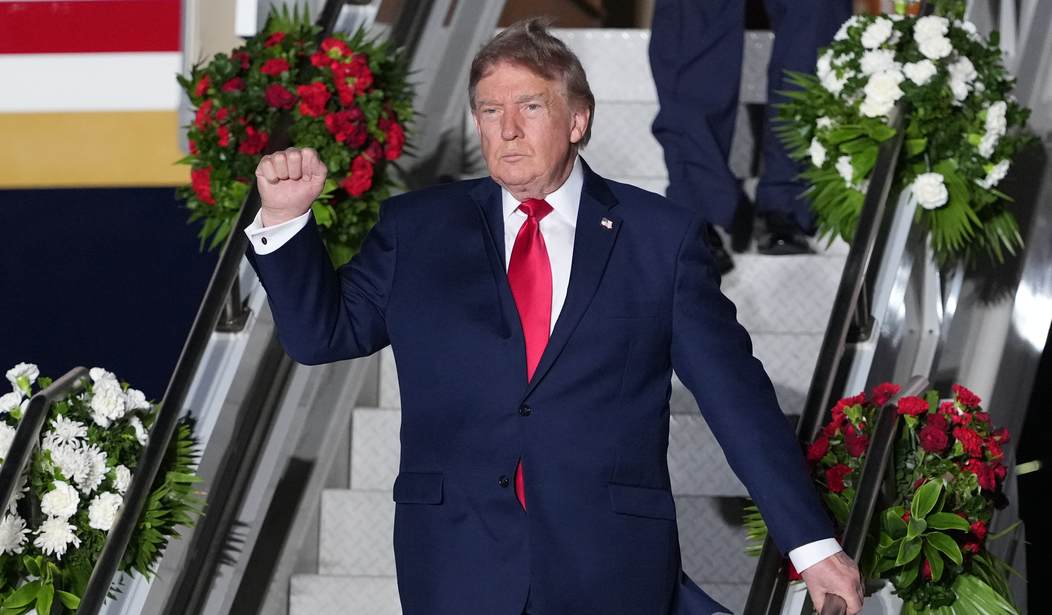
The only thing missing from this stunt is Greta Thunberg in an Iranian Navy uniform.
After President Donald Trump's notable interview last Thursday with Hugh Hewitt, much attention focused on the decision to keep the blockade of the Strait of Hormuz going against any vessels inbound to or outbound from any Iranian ports, while simultaneously providing a safe passage for all other commercial shipping.
The President said the blockade would remain indefinitely, even though he later admitted if the crazy regime in Tehran remained largely intact upon the end of his presidency, he would consider that a failure. The takeaway to deduce is that Trump believes the blockade will bring about the fall of the regime in fairly short order without the necessity of more kinetic military action. Iran may have other ideas.
Since last Thursday, as the regime thrashes around to survive and show a starving Iranian population it is still in control, more cracks in the bravado have appeared.
China, Iran's biggest oil customer, has moved on to other suppliers without so much as a "Dear Mojtaba" letter.
China imported 9.88 million barrels of crude a day in October, up 9.4% from September but down 13.3% year on year. Beijing can diversify suppliers. Tehran cannot replace lost export earnings that were exclusively coming from China.
— Saeed Ghasseminejad (@SGhasseminejad) November 13, 2026
Iran proposed a budget for next year that would rely on non-oil exports by way of a land route. Enter Operation Iron Gate.
The United States is building a land blockade around Iran to close the regime’s last supply routes and complete its economic strangulation. CENTCOM has established Task Force Iron Gate to extend the existing naval blockade to Iran’s land borders and Caspian Sea routes. The task force was ordered by CENTCOM commander Admiral Brad Cooper on November 7. It consists of approximately 20 civilian and military personnel based in Tampa who will coordinate with the Treasury, State Department, intelligence agencies and other American institutions. This is not a physical blockade involving American soldiers stationed along Iran’s borders. Iran has nearly 5,900 kilometres of land frontiers shared with seven countries, plus approximately 740 kilometres of Caspian coastline. Physically sealing that territory would be impossible. Iron Gate will instead use intelligence, satellite monitoring, financial tracking, sanctions and diplomatic pressure to disrupt the movement of weapons, dual-use technologies, sanctioned materials and illicit revenue. The task force is the next layer of the economic siege already being enforced at sea. CENTCOM says the naval blockade has prevented the Islamic Republic from exporting more than $25 billion in crude oil. Enforcement continues against vessels entering or leaving Iranian ports, while humanitarian shipments remain exempt. That blockade attacked the regime’s principal source of hard currency. Iron Gate targets the routes it began using to survive and rebuild. A Reuters investigation uncovered a covert network of more than 5,000 entities connected to Iran’s Defence Ministry. Since January 2025, the network imported at least $2 billion in explosives, rocket-fuel ingredients, titanium, precision machinery, aircraft components and heavy trucks capable of supporting missile operations. These supplies entered through several remaining corridors: ▪️ Russian-linked shipping across the Caspian Sea. ▪️ Truck routes through Iraq, Turkey, Turkmenistan, Pakistan, Afghanistan and Azerbaijan. ▪️ Air-cargo routes originating largely from China. Those imports allowed the Islamic Republic to replenish missile and drone inventories while American and Israeli strikes damaged its production facilities. Iron Gate is designed to make that military recovery slower, more expensive and less reliable. The operation could target trucking companies, shipping networks, banks, front companies and foreign intermediaries. Neighbouring governments may face sanctions or political pressure if their territory continues functioning as a supply corridor for the regime. Recent American pressure on Iraq to close all but two crossings with Iran demonstrates how the system could work. The United States does not require checkpoints on every road. It can pressure neighbouring governments to tighten borders, freeze payments and block the companies transporting sanctioned goods. The Caspian Sea will be the hardest route to restrict because it directly implicates Russia. Russian shipping and ports offer the regime a northern corridor that cannot be closed easily without confronting Moscow’s willingness to facilitate Iranian military procurement. The Islamic Republic will respond through shell companies, forged documents, bribery, covert flights and smuggling. Its borders are too extensive to seal completely. But complete closure is unnecessary. Every delayed shipment, sanctioned intermediary and restricted crossing raises the cost of rebuilding the regime’s military. The naval blockade deprives the Islamic Republic of revenue. Iron Gate targets what it can import with the money that remains. The objective is full-spectrum economic and military pressure without a ground invasion: deny the regime the oil revenue needed to finance terrorism and proxies, then deny it the materials required to rebuild its missiles, drones and weapons factories. The Islamic Republic survived the naval blockade by shifting its supply network inland. The United States is now moving to close the escape routes. https://t.co/TbkZR3piRO
— The Iran Watcher (@TheIranWatcher) November 7, 2026
The global oil market is getting over Iran in a big way now that the U.S. midterm elections are in the rearview mirror. And with it, so is Iran's ability to dictate terms of surrender.
🚨 BREAKING: US CRUDE OIL INVENTORIES RISE 3.38M BARRELS, ABOVE THE 0.4M EXPECTED. US oil supply is growing faster than expected, after a 4.657M barrel build last week. That is a second big build in a row. WTI is near $85 and Brent near $92, and both are down about 20% this month as Middle East exports rise and shipping costs fall. Cheaper oil is good news for inflation. Fuel is a big part of what companies and families pay, so lower oil can slow price growth and take some pressure off the Fed before the December meeting. A hike is still priced in, but oil is moving in the right direction for the Fed. The Iran conflict is what keeps oil from falling further. This week a tanker was attacked in the Strait of Hormuz, Iranian drones hit a US radar in Bahrain, and the US struck a missile site in Iran. About a fifth of the world oil normally moves through Hormuz, so one more escalation can send prices up fast. For the world economy, oil near $90 is still expensive for big importers like Europe, Japan and India. So two forces are fighting right now: more US supply pushes prices down, and war risk pushes them up. Over 12 years in these markets. Do not miss the next big move. Follow me and turn notifications on.
— DeFi_Machine (@DeFi_Machine) November 18, 2026
Not only is oil falling, gasoline is as well. And diesel, the lagging indicator, is beginning to moderate from its highs just a month ago. Iran's blustering doesn't have the same desired effect of causing the rest of the world economic pain from overpriced oil.
Just a few days ago, there were reports that the regime wanted to kill the President and members of his cabinet around the trip to Asia. Trump is on his way back, alive and well. There was the dirty bomb plot for the District of Columbia. D.C. still stands.
Inside Iran, you don't need to look very far to see the effects of Trump's big squeeze. Here's the largest commercial port in Iran — Shahid Rajaee. It used to be bustling with activity as it handled 80 percent of the containers coming in and out of Iran.
Iran’s most important commercial port stands empty - its quays deserted and cranes idle as the American blockade succeeds in choking the Islamic Republic’s global trade. Shahid Rajaee Port historically handled nearly 80% of Iran’s container loading and unloading and more than half of the country’s maritime imports and exports. IMF PortWatch data shows the port averaging approximately 1.4 ship calls per day over the past month—roughly half its pre-crisis rate of 2.7. Several recent days recorded no ships, imports or exports. The empty docks directly contradict regime claims that commercial activity is continuing normally under the American naval blockade. This means fewer machines, replacement parts, industrial components, raw materials, food products and consumer goods entering Iran. Land borders and Caspian routes cannot replace the enormous volumes historically processed through southern seaports. But the empty commercial port is only the visible part of a much deeper crisis. The Islamic Republic’s oil exports—the regime’s primary source of foreign currency—have been almost completely cut off. Before the blockade, Iran exported approximately 1.7 million to two million barrels of crude and condensate every day. Iran has not loaded a crude or condensate cargo since August 25, according to Kpler and the U.S. Treasury. The remaining oil stored outside the blockade zone fell from nearly 89 million barrels in July to zero by mid-October. CENTCOM says the blockade has already prevented at least $25 billion in Iranian crude exports. Because Chinese buyers generally pay one or two months after receiving shipments, Kpler expects the regime’s remaining oil income to dry up by mid-December. The Islamic Republic is already preparing for that moment. Iran’s Plan and Budget Organization has ordered next year’s budget to include a scenario in which oil revenue falls to zero. Oil historically provided approximately 30% to 40% of formal government revenue and Iran’s largest source of foreign currency. Once indirect income is included, some estimates place its contribution to total regime revenue considerably higher. That money funds salaries, subsidies, security forces, the IRGC, proxy networks and the patronage system that keeps the Islamic Republic functioning. The regime can reroute some containers through neighboring countries. It cannot replace millions of barrels of daily oil exports with trucks or railways. Production is being reduced as domestic storage fills and tankers remain trapped behind the blockade. Inflation is approaching 90%, the currency has collapsed and shortages are spreading throughout the economy. The empty cranes at Shahid Rajaee are not merely evidence of slower trade. They are the visible edge of an economic siege now reaching the Islamic Republic’s central source of power: its money. https://t.co/X3v3NZmEa0
— The Iran Watcher (@TheIranWatcher) November 16, 2026
Iran's banks? Teetering on the brink of insolvency at best.
A senior regime MP has admitted that 17 of Iran’s 28 banks fail minimum capital requirements—and six are already technically insolvent. Meysam Zohourian, vice-chairman of parliament’s Economic Commission, said only 11 banks meet the minimum 8% capital-adequacy standard designed to absorb losses and protect depositors. Seventeen fall below that threshold. Six have negative capital adequacy, meaning accumulated losses and weak assets have wiped out their regulatory capital. This is not an opposition estimate. It is an admission from a senior official responsible for overseeing the Islamic Republic’s economy. Other officials have confirmed the scale of the crisis. In October, the judiciary acknowledged that only 13 of 27 banks met the same minimum standard. The precise count varies by reporting period, but the conclusion remains unchanged: roughly half or more of Iran’s banking system lacks the minimum financial buffer required to withstand losses. The causes are embedded in the Islamic Republic’s economic model. Banks issued enormous loans to politically connected companies and shareholders, accumulated non-performing debt and filled their balance sheets with properties and other assets that cannot easily be sold at their reported values. Some institutions then became dependent on Central Bank overdrafts to remain operational. That transfers the losses of failing banks into the monetary system. The Central Bank creates liquidity to keep them alive, expanding the money supply and accelerating inflation and currency depreciation. Ordinary Iranians ultimately pay through higher prices and collapsing purchasing power. The 2025 dissolution of Bank Ayandeh demonstrated how this system works. Years of accumulated losses and insider lending were allowed to grow until the institution could no longer survive, leaving the state and public financial system to absorb the damage. Zohourian says the Islamic Republic already possesses the legal authority to place failing banks into resolution, seize bank assets and pursue the personal wealth of responsible managers and shareholders. His complaint is that officials still lack the will and urgency to use those powers. That is because these banks are not merely financial institutions. Many are connected to powerful political figures, state-linked foundations, major business networks and entities protected by the regime. Resolving them would expose who received the loans, where the money went and who benefited while the public absorbed the inflation. This does not mean every troubled bank will collapse tomorrow. The Islamic Republic can force mergers, guarantee deposits and create more money to postpone failure. But every rescue carries a cost. Recapitalizing insolvent banks consumes scarce state resources. Printing money accelerates inflation. Restricting credit suffocates productive businesses. Allowing a disorderly failure risks panic among depositors. The Islamic Republic is already losing oil revenue, access to maritime trade and control over inflation. It is now admitting that much of the banking system beneath that economy is financially hollow.
— The Iran Watcher (@TheIranWatcher) November 16, 2026
Iranian inflation? Even the New York Times has gotten into the act of explaining how withering life is inside the nation run by terrorists.
Our story about the cost of living crisis in Iran, which has gotten so bad that families are having to forego basic staples. “The harder we work, the less we seem to get in return.” With wonderful visuals by @adinarenner https://t.co/vBqQlVtf9U
— Yeganeh Torbati (@yjtorbati) November 19, 2026
Protests are spreading as an outgrowth of job-seekers being turned away from even applying. In this case, those with jobs simply trying to get to work sites get killed due to faulty equipment and transportation failures. Unrest in Iran is rising rapidly. This is in the western side of Iran, a Kurdish area called Abdanan.
Protests in Iran are starting once again. It’s the economy. The currency has crashed (2.7 million rials to $1)… there’s shortage of all essentials such as electricity, water, heating gas, fuel for cars… inflation is through the roof… meat has become a luxury… bread is rationed… there’s no money for shopping or eating out… unemployment has skyrocketed… and government workers are not getting paid on time.
— S.L. Kanthan (@Kanthan2030) November 18, 2026
One of the Iranian-backed militias in Iraq, Kataib Hezbollah, backed down from a Friday showdown deadline by Iraqi forces. They are crawling back amongst the rocks, hoping that they'll be able to slither out another day. But they also realize the regime that is their benefactor to the east no longer can help them.
Kataib Hezbollah is stepping back from an armed showdown with Iraqi state forces—but the emerging deal is a negotiated retreat, not the dismantling of the Islamic Republic’s militia network. After publicly resisting government demands over Jurf al-Sakhar, the militia’s leader, Abu Hussein al-Hamidawi, instructed fighters to resume normal duties and said disagreements with Prime Minister Ali al-Zaidi would be handled through “private channels.” That signals de-escalation, not preparations to fight the state. Government forces are expected to enter the area on Friday, November 20, under a compromise brokered by senior Shiite leaders. Iraqi security spokesman Lt. Gen. Saad Maan said Kataib Hezbollah forces would move elsewhere. The deployment is still prospective—not a completed takeover. To understand the outcome, separate three things: territory, money and weapons. On territory, al-Zaidi has extracted a concession. Kataib Hezbollah has maintained an armed presence in Jurf al-Sakhar since 2014. Establishing a government command there would challenge its ability to decide which state institutions can enter and operate. But the incoming force matters. The arrangement includes Army, Federal Police and Popular Mobilization Forces units, with Energy Police assigned to the pipelines. Some reporting indicates that Kataib Hezbollah personnel could remain through the PMF component. That would make this a negotiated security arrangement—not necessarily the militia’s complete removal. On money, the oil investigation gave al-Zaidi leverage. Authorities accused a network operating through the stronghold of siphoning state-owned oil. Nine senior security and oil officials were dismissed. This gave the government a concrete case about stolen public revenue, rather than relying solely on a politically divisive demand for disarmament. Kataib Hezbollah denies the allegations. The economic result will depend on enforcement. Putting Energy Police beside pipelines matters only if they can inspect freely, prevent unauthorized access and stop illicit movements. A new headquarters alone does not prove that a protected revenue stream has been shut down. On weapons, this is not disarmament. Redeploying fighters does not confiscate their arsenal, dissolve their command structure or end their political influence. The militia can surrender some territorial exclusivity while preserving much of its wider power. That also explains Esmail Qaani’s intervention. Kataib Hezbollah says its leadership met the Quds Force commander alongside Hadi al-Amiri and Falih al-Fayyadh. The likely priority was damage control—prevent a confrontation that could hurt the Islamic Republic’s proxy while preserving the broader network. Qaani’s mediation demonstrates continuing influence, but not an ability to make the government’s challenge disappear. Al-Zaidi also faces constraints. Figures within the governing Coordination Framework reportedly resisted a combat operation. He has secured movement through pressure and negotiation—not demonstrated that he can launch an unrestricted campaign against every armed faction. The clearest assessment is a limited gain for Iraqi state access and a retreat from Kataib Hezbollah’s public defiance. Neither amounts to a strategic defeat of the IRGC’s Iraqi network. Friday’s test is practical: who leaves, who stays, who controls the checkpoints and pipelines, and whether government investigators can work without militia permission. If those powers genuinely change hands, al-Zaidi has established a precedent. If militia control survives beneath a new command structure, the deal will have changed the sign above the door more than the authority behind it.
— The Iran Watcher (@TheIranWatcher) November 19, 2026
In Gachsaran, south of the three Iranian oilfields and the gateway to the Kharg Island pipelines, more protests and demonstrations.
🚨🦀 دومین روز اعتراض جوانان جویای کار در گچساران با مسدود کردن مسیر پتروپالایشگاه لیشتر/جوانان جویای کار منطقه بابکان برای دومین روز متوالی در اعتراض به وضعیت اشتغال، مسیر دسترسی به پتروپالایشگاه لیشتر گچساران را مسدود کردهاند. بر اساس گزارش منتشرشده، این اقدام اعتراضی همچنان ادامه دارد و مسیر دسترسی به مجموعه پتروپالایشگاهی بسته است.
— ✡︎𝐋𝐢𝐯𝐞𝐈𝐫𝐚𝐧𝐍𝐞𝐰𝐬🇮🇷🇮🇱 (@IranNewsAgency0) November 19, 2026
They're blocking access to a refinery. Remember, Iran doesn't have enough refining capacity as it is to meet the country's gasoline and diesel fuel demand. And now, Iranians looking for work at places functioning at capacity are still being turned away, and they're not happy about it.
We've heard the President, Secretary of State Marco Rubio, and Treasury Secretary Scott Bessent all say within the last few weeks that as the sanctions continue to escalate and cripple the regime, at some point, people have to eat. And that's hard to do inside the IRGC and Basij forces when they're not getting paid. This is what some of the vaunted security forces of Iran look like now.
The Islamic Republic’s forces are struggling with basic necessities—facing unpaid salaries, inadequate food and reliance on civilians for warm clothes. In a circulating video, armed men identifying themselves as forces deployed from Mashhad to Khuzestan thank local civilians for supplying warm clothing. Accompanying claims say they also lack money for food and accommodation. The footage adds to reports of financial and logistical pressure reaching the security apparatus—not just ordinary Iranian households. CENTCOM commander Adm. Brad Cooper has said the IRGC is failing to pay its troops. He also cited reports that Iran-aligned militias were withholding payments from their own fighters to redirect money back to the IRGC. That would reverse the relationship the Islamic Republic spent decades building—its regional clients helping finance the organization that traditionally funded them. Treasury Secretary Scott Bessent has likewise said the regime cannot pay its troops and is struggling to obtain dollars to replenish resources. Other reporting describes IRGC and Basij personnel waiting months for salaries. Earlier reports involving police Special Units, army personnel and retirees described repeated payment delays, low morale and some personnel refusing to attend pro-regime gatherings. The pressure comes as the U.S. naval blockade and sanctions restrict oil income and access to foreign currency. President Masoud Pezeshkian has himself acknowledged substantial economic difficulties caused by the strikes and blockade, while Iranian authorities reject claims of imminent collapse. The IRGC remains the regime’s central survival force, and individual complaints do not establish that the entire apparatus is breaking down. But paying personnel late, providing inadequate supplies and relying on donations impose a cumulative cost on morale and reliability. The regime can demand sacrifice indefinitely. It cannot assume that loyalty will indefinitely replace salaries, food and shelter. https://t.co/aFuitTOnj9
— The Iran Watcher (@TheIranWatcher) November 18, 2026
Medical equipment in hospitals and clinics we take for granted are simply unobtainable in Iran.
An MRI machine in Iran now costs between 1.8 trillion and 2 trillion rials (approximately $674,000 to $749,000), putting the equipment beyond the financial reach of charitable donors, a senior Iranian lawmaker said Wednesday. Ruhollah Lak Aliabadi, deputy chairman of parliament's Health Committee, told the parliament's ICANA news agency that the cost of medicines, medical treatment and equipment had risen sharply, placing increasing financial pressure on patients and healthcare providers. He called on the Health Ministry to allocate a dedicated budget for expensive medical equipment, saying charities could no longer be expected to cover the cost of essential diagnostic machines such as MRI scanners. https://t.co/J46hTncJk8
— Iran International English (@IranIntl_En) November 18, 2026
So what does a dying, desperate regime do when the weather is getting colder and there's no economic relief in sight? Go full Greta Thunberg.
N12: Iran is weighing a breakout attempt against the U.S. blockade, using a swarm of loaded oil tankers.
— Open Source Intel (@Osint613) November 19, 2026
Throughout the length of time the Operation Economic Fury and Project Freedom have been in force, any attempt to break the blockade has resulted in either disabling, sinking, or outright seizure of the tanker. I believe at least three that were loaded with Iranian crude ended up being added to U.S. inventories after the ships were liberated of their crews and rerouted to the Gulf of America. This would be the first time they try to load up several and attempt to a bullrush through the Strait. And it wouldn't be Iran without the threat of what will happen if the U.S. were to act.
Any U.S. Navy action against an Iranian oil tanker flotilla would be met with attacks on oil and gas infrastructure in other Middle Eastern countries, according to the IRGC-affiliated Fars News Agency. The outlet confirmed Tehran plans to send the tankers to break the U.S. naval blockade.
— Open Source Intel (@Osint613) November 19, 2026
Tanker Trackers confirms that Iran for the first time in a very long time is loading up a ship at Kharg.
BREAKING: Iran appears to be preparing to ship out oil again. #OOTT #IranWar #Tankers
— TankerTrackers.com, Inc. (@TankerTrackers) November 19, 2026
Perhaps miscalculating that rotating out the Washington carrier group back to Japan as the H.W. Bush and Teddy Roosevelt are on station as a sign of reduced capacity, or whether it's just flat-out desperation, the regime is indicating it can no longer hunker down and ride out the Trump administration. This move, if they indeed proceed with it, is a blinking beacon that even the regime believes it's curtains for them unless they figure out a way to get back in the oil business again and change the status quo.
What are Trump's options? Well, to borrow a phrase, he has a boatload of them.
1) Disable them one after another, which would be risky in the sense that you'd have a lot of immobile hazards in an already-narrow chokepoint.
2) Sink them. (Always a fun option so long as there are videos for show prep.) But that would certainly make a mess.
3) Let ships through one at a time, then seize them in the Arabian Gulf. They can be picked off, disabled, parked, or sunk at a time and location of our choosing. The oil on them is sanctioned oil, unsellable anywhere in the world without secondary and tertiary sanctions on entities that accept them. And the Treasury has gotten very good at interdicting any oil profits before it would get back to Iran even if the ships did get to ports. In short, Iran simply does not possess very many pieces left on the chessboard.
4) Take out Kharg Island while they're building the flotilla by loading the ships. That would certainly send a message.
5) All of the above.
Iran does not have military force to escort the tankers. They're allegedly relying on the safety in numbers caravan with threats to six Arab states as a shield. If Iran does unleash a barrage of missiles and drones once the U.S. Navy inevitably cripples the flotilla, it's probably game on for the last time with this regime. They're hungry and feel they have nothing left to lose, and Donald Trump wants to finish them one way or another before the '28 primaries get started. If the regime wants to go out in a blaze of glory, Trump seems willing to be their huckleberry.
Of course, if Iran tries to run the blockade and fails spectacularly, and they follow up the bluster by an anemic response or worse, none at all, that's pretty much the end of the regime's credibility. The Arab states will no longer fear them, the Iranian population wanting freedom won't fear them to the same degree, and we may soon see the end of the reign of terror from Persia as the house of cards collapses.
I'm assuming that if Space Force can read "Mohammed" on the nametags of Iranian shirts, as President Trump has famously said, I'm fairly confident we can see exactly what the Iranians are putting together. And I'm more than confident that our military will be able to handle whatever comes at them.
In naval terms, what Iran is allegedly plotting is a turkey shoot a week before Thanksgiving. Let's get this boss fight behind us once and for all.
Editor’s Note: Thanks to President Trump and his administration’s bold leadership, we are once again respected on the world stage, and our enemies are being put on notice.
Help us continue to report on the administration’s peace through strength foreign policy and its successes. Join HotAir VIP and use promo code FIGHT to receive 60% off your membership.

Join the Conversation
VIP members get the ability to comment on articles.