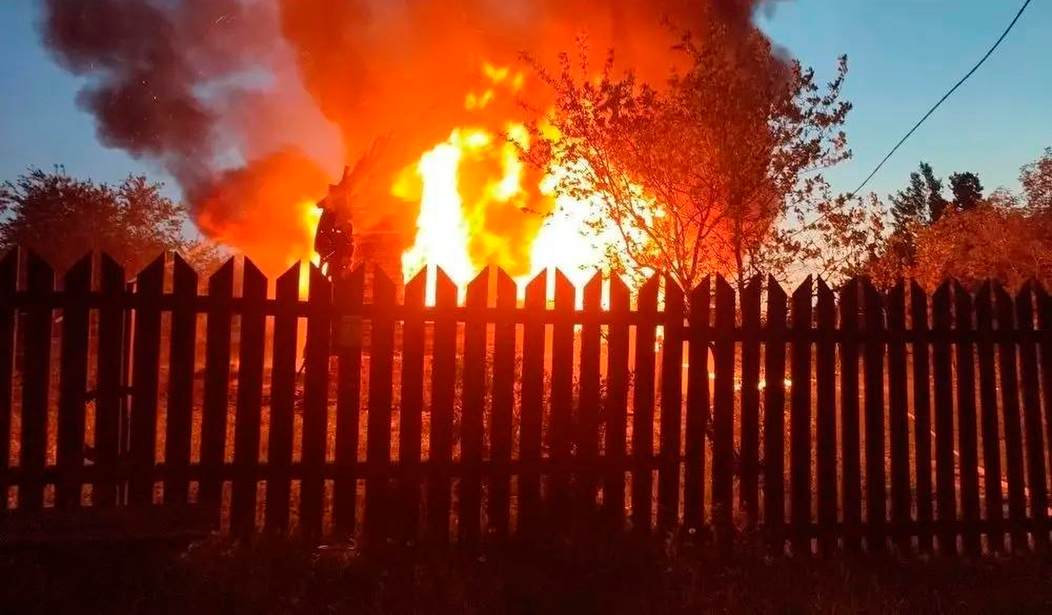
They Syzran oil refinery is more than 900 kilometers from Ukraine, but early this morning a group of drones struck the refinery and set it on fire.
Unmanned Systems Forces and Special Operations Forces struck the Syzran oil refinery
— 🇺🇦 Unmanned Systems Forces (@usf_army) May 21, 2026
On the night of May 21, operators of the @1usc_army and the @Raid_413, in coordination with the @SOF_UKR, struck the Syzran oil refinery in the Samara region of russia.
The "Syzran Oil Refinery"… pic.twitter.com/h8jLr0eqtq
Russia has confirmed the strikes.
Ukrainian drones struck Russia’s Syzran oil refinery early morning on Thursday, May 21, sparking a massive fire at one of Rosneft’s major fuel-processing facilities as Kyiv’s long-range campaign against Moscow’s energy infrastructure intensifies.
Governor Vyacheslav Fedorishchev confirmed the strike on the city of Syzran in Russia’s Samara region, claiming two people were killed and several others injured.
Russian officials blamed “enemy” drone attacks, while local footage shared online showed towering flames and thick black smoke engulfing the refinery complex.
These piecemeal strikes are having a pretty significant cumulative impact on Russia's oil output. Reuters had a new story about that yesterday.
Virtually all major oil refineries in central Russia have been forced to halt or scale back fuel output following Ukrainian drone attacks in recent days, according to official data and sources.
Moscow already introduced gasoline exports ban starting from April until the end of July.
The combined capacity of refineries that have fully or partially halted operations exceeds 83 million metric tons per year, or around 238,000 tons per day. That accounts for around one quarter of Russia's total refining capacity, according to data and sources who spoke on condition of anonymity.
The combined share of the refineries in Russia's fuel output is over 30% for gasoline and about 25% for diesel.
Russia has gotten a boost from the increased price of oil thanks to the Strait of Hormuz being shut down but that won't last forever. The Telegraph has a story today assessing Russia's current economic situation.
In March, Russia’s oil exports surged from $9.8bn to $19bn, the highest total since 2023, according to the Kyiv School of Economics Institute.
But the Ukrainian attacks hurt, and they are only going to intensify.
“This will build over the summer as Ukraine becomes more effective with their long-range strikes,” says Luke Coffey, senior fellow at the Hudson Institute.
Crucially, the boost to oil revenues from the war in Iran has also been nowhere near enough to rescue Russia from economic malaise. “The expectation was that the war in Iran would give new momentum to Russia and it hasn’t,” says Timothy Ash, associate fellow at Chatham House’s Russia and Eurasia programme.
Official data show Russia’s GDP shrank by 0.2pc in the first three months of the year, contracting for the first time since 2023. Earlier this month, the economic ministry cut its forecast for annual GDP growth in 2026 from 1.3pc to 0.4pc. Analysts think the reality will be far worse than officials will admit.
“This is a new, more difficult phase for the Russian economy. Almost every indicator that you can think of for the Russian economy is heading in the wrong direction. Russia is probably already in recession,” says Charles Hecker, an associate fellow in international security at the Royal United Services Institute.
I've written about this before but some analysts believe that even the middling numbers Russia has been reporting are being faked. The real state of the economy may be much worse. Sweden's foreign minister made this case yesterday.
There are several reasons to believe that Russia has been exaggerating its economic strength. Russia has claimed that its economy grew by around 13 percent between 2020 and 2024, but by measuring nighttime luminosity, an established way of assessing economic activity in countries where official statistics are not available or cannot be trusted, we have estimated that the economy actually contracted by around 8 percent during this period.
We also believe inflation is substantially understated. In 2024, when inflation in Russia was reportedly around 10 percent, the central bank raised the benchmark interest rate to 21 percent, suggesting that inflation was higher. And Sweden’s Military Intelligence and Security Service believes that it is higher than the current official forecast of around 5 percent. This would mean Russia is overstating its purchasing power, and that its military spending capacity is weaker than it appears...
Russia’s economy, in nominal terms, is barely bigger than the State of New York’s, smaller than that of Texas and fragile. Russian households are feeling the pinch of daily expenses, and the lion’s share of the liquid assets in the country’s national wealth fund — its financial buffer — has been drained to finance the war. The weakness in the economy shows how effective Western sanctions have already been, and why further pressure is the best way to force Mr. Putin to engage in serious peace negotiations.
And finally, things continue to not go well for Russia on the battlefield.
As recently as December, Russia was claiming nearly seven square miles of Ukrainian territory every day, according to the ISW. This year, these advances began slowing until, in April, Ukraine started making net territorial gains for the first time since July 2023.
So far this month, Ukraine has reclaimed an average of eight square kilometres per day from the Russians.
All of this adds up to an increasing sense inside Russia that things are not going well and also an increasingly willingness to say so, though that's still relatively rare.
Renat Suleymanov, a member of the Russian State Duma from the Communist Party of the Russian Federation faction, has stated that the Russia-Ukraine war must end "more swiftly" as Russia's economy "cannot sustain the prolonged continuation of the special military operation"...
This is likely the first such statement made by a State Duma member, Russian news outlet Agentstvo.Novosti notes.
Six months ago, Russia's position looked pretty strong. At the moment, that's clearly not the case. That doesn't mean Russia is going to collapse, but a recession or another round of forced mobilization seem like they could be on the horizon and either or both of those will be very unpopular.
Editor’s Note: Thanks to President Trump and his administration’s bold leadership, we are respected on the world stage, and our enemies are being put on notice.
Help us continue to report on the administration’s peace through strength foreign policy and its successes. Join HotAir VIP and use promo code FIGHT to receive 60% off your membership.









Join the conversation as a VIP Member