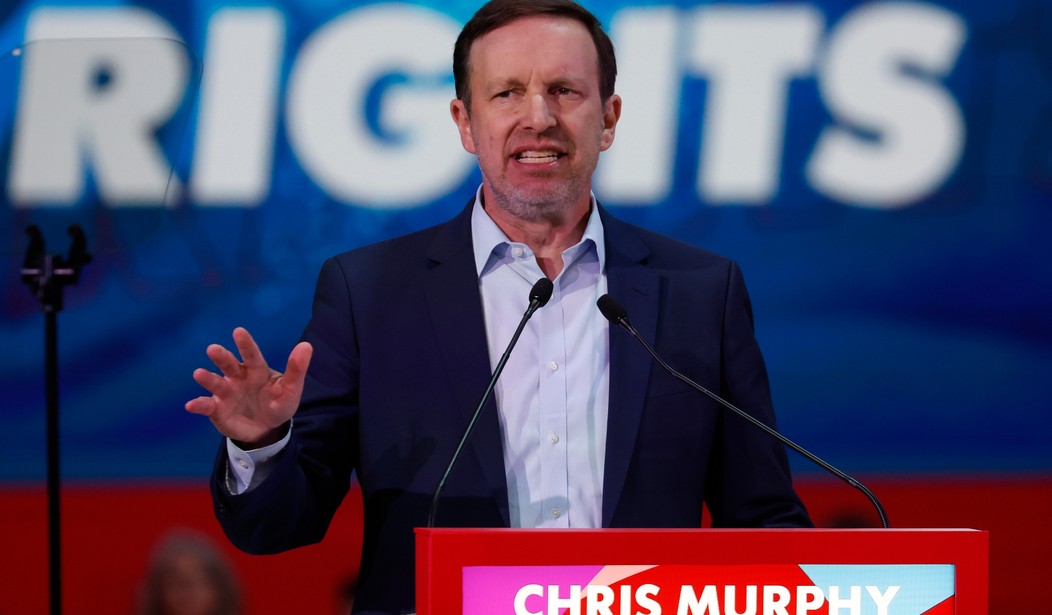
Maybe it's not fair to call it a new idea since it's one that has been around for a long time. But Sen. Chris Murphy is newly pushing for it to become law as part of an effort to win over moderate voters.
The plan? Murphy wants to raise the federal minimum wage to $25 an hour. Not all at once but relatively soon for big businesses.
Last week, Sen. Chris Murphy (D-CT) introduced the Senate version of the Living Wage for All Act, which raises the federal minimum wage from $7.25 to $25 per hour — a 245 percent increase — over 12 years. It begins by increasing the minimum wage 66 percent to $12 an hour and then establishes separate schedules for large and smaller employers, with the former being required to raise hourly pay to $25 in only 5 years.
Murphy then went on Meet the Press last week to defend this bill.
Murphy: I’m not a democratic socialist, but I do believe that the Democratic Party has been historically way too timid in taking on corporate power. I think our party should have bigger ideas. I put one on the table last week, a $25 minimum wage. And I think we do have to have answers for the way in which corporations and billionaires are taking over and corrupting our politics...
I think we have to understand that people do not believe that this version of capitalism has worked. And frankly, it hasn’t worked. I mean, you have 40% of Americans today that are working full time and don’t have enough money saved up in the bank for an emergency car repair. Meanwhile, we just saw the first trillionaire made in this economy. This version of capitalism isn’t working. Now, I make the argument in the book that we should embrace, you know, what I call a common good capitalism. A capitalism where we have more shared prosperity, where we want more millionaires and less trillionaires. Where we have a higher minimum wage, where unions are more powerful. Democrats are not going to win by defending this version of capitalism. But I think we’ll be able to offer ideas on how to dramatically reform it rather than throwing out the entire system.
The conversation eventually came back to his plan for a $25 an hour minimum wage.
The key line here is this one: "And by the way, we can afford it. It’s not like we can’t pay a $25 minimum wage, we just choose not to because we’ve become okay with dozens and dozens of people in this country making hundreds of billions of dollars."
Every bit of this is nonsense. As the Washington Post editorial board asks, who is "we"?
Who’s “we”? Businesses have to cover the cost of higher wages somehow — hiking prices, shrinking hours, laying off workers or hiring fewer are all on the table. A higher minimum wage also increases the incentive for automation.
Some states already know the effects of raising the minimum wage beyond what the market can bear. California set a $20 wage for fast-food employees in 2024. That eliminated 18,000 jobs within a year, according to an analysis in the National Bureau of Economic Research.
We in this case literally means everyone who winds up paying much higher prices for everything if Murphy's bill passes. That's what will happen. He's just hoping Democrats are too dim to know it. Also, the Post backs up the interviewer's claim about the expected job losses from a wage hike like this.
Murphy claimed that “plenty of economic analysis” shows his plan will “create more jobs than you’re gonna lose.” Yet the nonpartisan Congressional Budget Office estimated a $17 minimum in 2029 would put 700,000 people out of work. Imagine the damage of a $25 floor.
It's not like any of this is new territory. The arguments against this idea have been around a long time.
While this bill is unlikely to pass, news-making proposals like a $25 minimum wage provide an opportunity to revisit why most economists oppose any wage floor at all. They force higher costs onto employers, which winds up disproportionately hurting hourly workers.
Today, much of the US enjoys non-binding minimum wages. That is, 99 percent of employees already earn above the federal minimum because local labor conditions and productivity push wages higher. According to the Cato Institute, the median effective minimum wage was $13.73 in January 2026. Mandated increases beyond this level bind employers to artificially high wages.
Once the minimum wage becomes binding, employers face trade-offs: mainly, fewer non-wage benefits. Another Cato study found that after California increased its minimum wage from $11 to $12, the average affected employee worked five fewer hours per week. Fewer workers qualified for employer-sponsored health and retirement plans, while average wages actually fell by 13.6 percent.
Again, the guaranteed result of this plan is job losses and inflation as the cost of nearly everything goes up. That's already the case here in California where the cost of two meals at McDonalds is well over $30.
Two years ago, a hotly contested law imposing a $20-per-hour minimum wage on franchised fast food outlets took effect...
On Wednesday, University of California – Santa Cruz released a real world appraisal of how the $20 mandate has affected owners and employees of fast food franchises. Stephen Owen, an economics lecturer, and a team of undergraduate helpers visited and studied more than 100 outlets in Santa Cruz and the Central Valley and came away with data that seem to validate industry predictions of the effects...
“Employees have been impacted with fewer job opportunities, reduced employee hours, elimination of overtime, and new eligibility challenges for healthcare and other benefits. Automation, such as order kiosks, mobile apps, Artificial Intelligence drive-through ordering systems, as well as other innovative assembly technologies, are being tested and implemented with the goal to reduce labor requirements.”
The bottom line here is that this sounds good to people who know nothing, which is Murphy's intended audience. Then when prices on everything spike, he and his fellow Democrats can run on affordability and demand more socialism to fix it. Fortunately, some voters have caught on.
Oklahomans rejected a ballot initiative last month that would have raised their state’s minimum to $15 over three years. Two efforts in California and Massachusetts — hardly laissez-faire territory — were shot down by voters in 2024. Murphy’s proposal would take away this state-level choice...
Murphy pretty clearly wants to run for president or maybe vice president. If this is the best he has to offer, even Democrats should be ready to pass.
Editor's Note: It’s America’s 250th birthday! Help HotAir celebrate the greatest nation in history by honoring its past, defending its present, and preserving its future with reporting you can trust.
Join HotAir VIP and use promo code AMERICA250 to receive 74% off your membership.









Join the conversation as a VIP Member