
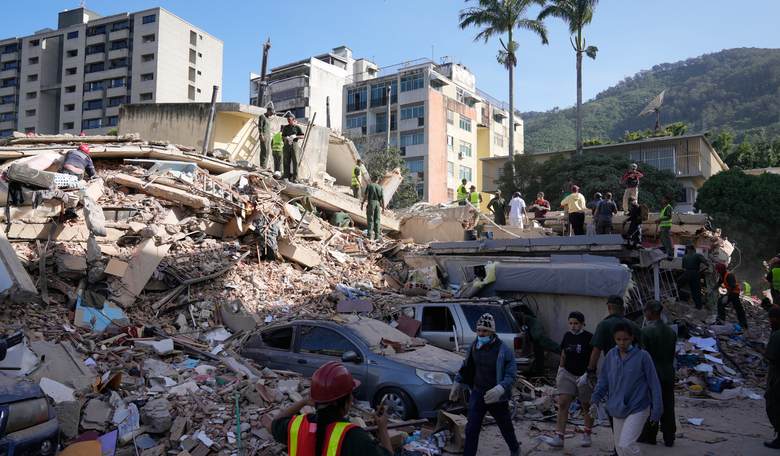
Back in June, two massive earthquakes hit Venezuela on the same day. They were rated at 7.2 and 7.5 on the Richter scale. The immediate result was many large buildings collapsing, killing anyone trapped inside.
Here's another clip from right after the quake struck.
This was about six months after the U.S. grabbed Nikolas Maduro and put him in prison. But most of his ineffective government was still in place.
"Maduro's capture by U.S. forces in January might have decapitated the regime, but it did not change or reset the institutions the regime built," Orlando Pérez, a political science professor at the University of North Texas at Dallas, said in an email.
"Six months is not enough time to rebuild institutions that took two decades to hollow out," he said. "The earthquake struck a country that had no slack left to absorb a shock of this magnitude."
Pérez said Venezuela's government has been organized around "two priorities: regime survival and resource extraction."
"Hospitals were already running without basic medicine and equipment. The armed forces had been restructured to prevent coups, not to serve civilians," he said.
Some of the worst hit buildings were government constructed housing built in an area where scientists had warned the government not to build at all.
Scientists had warned the government not to build along Venezuela’s coastal strip of La Guaira.
The area’s seaside Caribbean communities, not far from Caracas, were near a major fault line and a mountain range that had unleashed repeated, destructive natural disasters. The soil was poor, a type of silt that would only amplify shaking in an earthquake.
Ignoring the advice, the government threw up exactly the wrong kind of buildings for that location: tall concrete apartment complexes...
When Venezuela was rocked by the 7.2- and 7.5-magnitude earthquakes, at least 14 apartment towers in La Guaira fell nearly at the same time, pancaking one floor on top of another, trapping hundreds inside.
The official government death toll from the quakes now stands at 6,509, but there is ample evidence that the real toll is much higher.
Venezuela’s government says 6,509 people died in the back-to-back earthquakes in June. But calculations from multiple sources, including a New York Times analysis of residential buildings and the U.S. Geological Survey, indicate that this is likely a severe undercount...
For the Venezuela quakes, the U.S.G.S.’s median estimate is that 53,000 people died — meaning there is a 50 percent chance the actual number is higher than that, and a 50 percent chance it is lower.
The U.S.G.S. also says there is approximately an 81 percent chance that the real number of deaths is higher than 10,000.
Even the number of buildings that fell is contested.
While Venezuelan officials have publicized data saying that 190 buildings fell completely, a government minister overseeing a commission reviewing the damage, Francisco Garcés, told The New York Times that the real number is far higher — 656 buildings and 370 homes, all collapsed or partially collapsed.
As mentioned, most of the big collapsed buildings were public housing projects. There's a separate story taking a close look at why they collapsed so quickly. A big part of this falls on the shoulders of deceased communist strongman Hugo Chavez.
The soaring white towers were a signature project of Venezuela’s Socialist icon, Hugo Chávez, built in the coastal state of La Guaira to house thousands of poor government supporters.
For years, their promoters bragged about how fast they were built...
The Times investigation revealed that the buildings were so fundamentally flawed that they became death traps. Simple, widely used engineering techniques could have strengthened the towers and saved lives. When they collapsed, the buildings were less than 15 years old.
Chavez has been dead for 13 years but this is part of his legacy. These death traps were part of a campaign promise.
Mr. Chávez announced his Great Housing Mission in 2011, with his movement facing a pivotal election the next year. Then the president announced he had cancer. Months earlier, thousands of Venezuelans, many of them Chávez supporters, had lost their homes to devastating mudslides.
The pressure was on. The president promised three million homes by 2019. The goal was to give every disaster victim a place to live. Andrés Izarra, a government minister at the time, likened the housing blitz to a “war effort,” adding, “That’s how we got re-elected.”
There's a pretty good video here explaining the technical reasons why the towers went down so quickly. Had they been better built more of them may have survived. But as it was the outcome was inevitable.