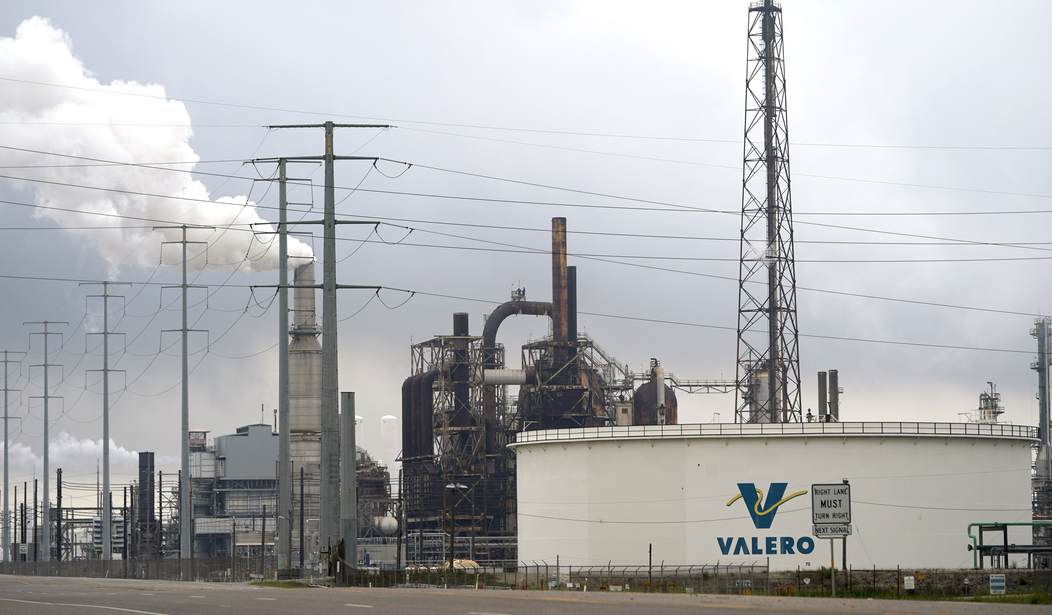
Perhaps you've heard - gas prices are up. Something about a war.
"But wait", you might say, "I thought the US was energy-independent!"
Well, we do drill plenty of oil and natural gas, it's true.
But if you can't refine the oil into whatever you need - gasoline, diesel, jet fuel, makeup, plastic - then it's just...oil.
And the problem is, the US has not built a new oil refinery in a long, long time (emphasis added).
The newest refinery in the United States is the Texas International Terminals 45,000-barrel per day (b/cd) refinery in Galveston, Texas, which started operating in February 2022.
However, the newest refinery with significant downstream unit capacity is Marathon's facility in Garyville, Louisiana. That facility came online in 1977 with an initial atmospheric distillation unit capacity of 200,000 b/cd, and as of January 1, 2026, it has a capacity of 617,000 b/cd, making it the third-largest refinery in the United States.
That's almost 50 years since the last new, large refinery. And the Biden Administration slowed down the work on whatever was brewing.
Now, one thing the US does have is old refineries, taken offline for obsolescence, economics and wear and tear.
And the White House has its eye on them:
White House officials are huddling w/potential investors to revive defunct petroleum refineries -- from the Virgin Islands to Calif. -- amid rising anxieties over higher fuel prices.
— Hannah Northey (@HMNorthey) July 30, 2026
In the mix: Backers of the Freedom Fuel Network
W/@jamepdx @bjlefebvre for @politico https://t.co/EbjxtRd85z
TotalEnergies completed repairs and restarted the crude distillation units at its 238,000 barrel-per-day Port Arthur, Texas refinery, said two people familiar with plant operations on Wednesday.#oott https://t.co/Dx8v3CmFZv
— Giovanni Staunovo🛢 (@staunovo) July 30, 2026
The Trump administration is looking to reopen closed oil refineries, including an embattled one in the Virgin Islands, amid high gasoline prices spurred by the Iran war.
A White House official confirmed to The Hill in an email Thursday that the Trump administration “would like to see refineries across the country reopen, especially the St. Croix refinery.”
The official said this refinery is of particular interest because it was built to refine Venezuelan oil and because of its “strategic” location.
The official said that since April 2025, companies have approached the administration to express interest in purchasing the refinery and that this has ramped up since the capture of Venezuelan leader Nicolás Maduro and U.S. takeover of the country’s infrastructure.
And this could help California, in theory, shed its image as an energy money pit:
It seems impossible to imagine, but the Golden State was once an energy powerhouse. Oil production peaked in 1985, then declined as fields matured, offshore production was heavily restricted, and environmental laws strongly discouraged new drilling. As for refining, Sacramento has been at war with that industry for most of the 21st century. California had more than 40 refineries in the 1990s, and fewer than a dozen today. State laws and regulations (plus cap and trade) make it just too expensive to refine there.
California's former powerhouse status was by necessity, not happenstance. Stein and Ariza call California an "energy island" cut off from the rest of the nation by the Sierra Mountains. They report that the "58 million gallons of transportation fuel" that the state requires each and every day breaks down like so:
- 11 million gallons/day for jet fuel for the state's military and international airports.
- 10 million gallons/day for diesel for the state's trucking and construction industries.
- 37 million gallons/day for gasoline for the state's more than 36 million vehicles.
Because, to be frank, California is an energy basket case:
How bad is it, really? Stein and Ariza note that "In just the last two months, California has been forced to import more jet fuel from the Gulf and East Coasts, via ships through the Panama Canal, than in the past 36 years combined.":::::::
And while we just happen to be at war, California's military reserves are being depleted: "Despite Gulf Coast refineries running at a grueling 98% capacity, California still required substantial emergency draws from the nation’s military fuel storage reserves to prevent a systemic collapse and fuel rationing."
So - is it cheaper to build new or remodel?
We're about to find out.