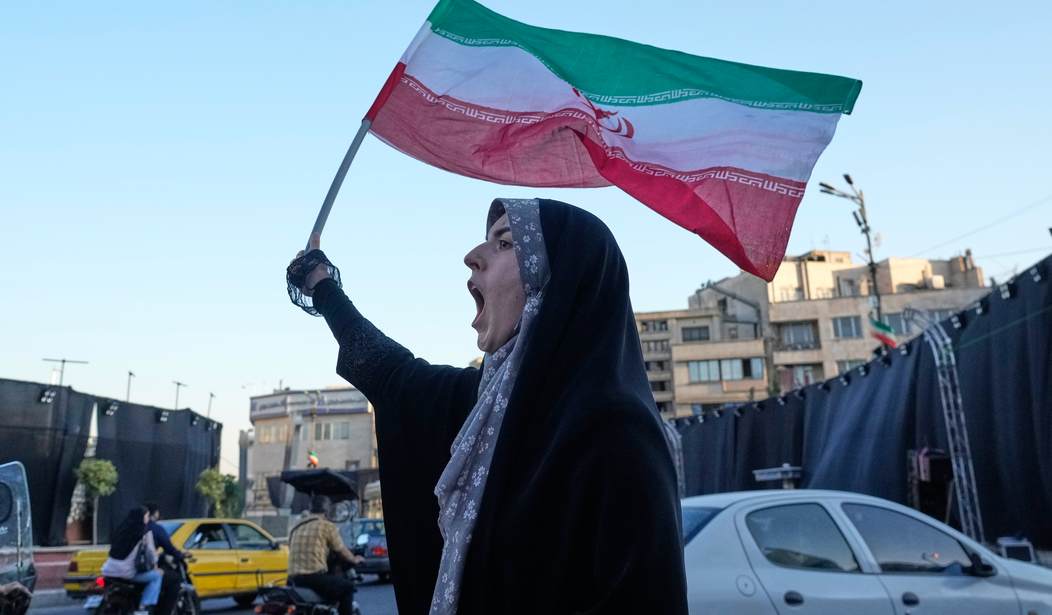
It's time to release the Memorandum of Understanding between the United States and Iran.
Speculation is running rampant about what's in it, and leaks from the administration are making Trump's allies very nervous because they all seem to suggest that Iran's propaganda about what's in it is largely accurate. Vice President Vance is spinning like a top that it's really a great deal, and all the great benefits Iran claims it will get depend on performance, but unless we know what is in the MOU, we don't know what "performance" really means.
.@VP: "You see the propagandists who are saying 'Here are all the things Iran gets!' ... the big print in the actual agreement is they don't get ANY of that stuff unless they totally transform themselves as a country — and if they do, that's a huge win for everybody." pic.twitter.com/wPv831Cd7R
— Rapid Response 47 (@RapidResponse47) June 16, 2026
One thing we do know is that Iran's interpretation of the MOU includes a complete Israeli withdrawal from Lebanon and no strikes on Hezbollah, and it sure sounds like Trump is on board with that.
Iranian Foreign Minister Abbas Araghchi:
— Open Source Intel (@Osint613) June 16, 2026
The end of the war will not be complete without the withdrawal of Israeli forces from the territories they occupied in Lebanon.
Any military attack by Israel on Lebanon and the continued occupation of Lebanese territories from now on, in… pic.twitter.com/4fu3wEy4Yi
Hezbollah claims that Iran has assured it that any nuclear deal will require Israel's complete withdrawal from Lebanon. Trump, while not endorsing that notion directly, did criticize Israel's actions in Lebanon and suggest that Syria be given the job of dealing with Hezbollah.
"You don't have to knock down an apartment house every time you're looking for somebody, because there are a lot of people in those apartment houses, and they're not all Hezbollah." — @POTUS on Israel's strikes in Lebanon. pic.twitter.com/SATu1waIKS
— Trump War Room (@TrumpWarRoom) June 16, 2026
What's really striking about that isn't that Trump said something off the cuff; his social media team highlighted those comments as especially important, sending a signal to everybody, including Israel and Iran, that he implicitly endorses tying Hezbollah's survival, or at least protection from Israeli attacks, as part of the deal.
Trump: "The current Iranian leadership are very rational people. They are nice to deal with, they are strong and smart people. They are not radicalized, and they are looking to help their country." pic.twitter.com/5QRUNGtg2i
— נועה מגיד | Noa magid (@NoaMagid) June 16, 2026
Even more striking is that Trump seems to be backing off, slowly, from his demands for Iran's "nuclear dust," saying that it's just not valuable and it would cost too much to get it.
Trump is backing away from getting Iran's enriched material: "You could make the case, why even bother? It's not very valuable stuff." pic.twitter.com/CgNgnZCaMQ
— Aaron Rupar (@atrupar) June 16, 2026
That's singing a very different tune from the one we heard before and during the war.
The Institute for the Study of War, while not providing an analysis of the MOU since we don't have it, does analyze the descriptions provided by Iran, many of which seem to correlate with leaks from within the administration, and concludes that they don't look so hot.
2/ MORE: The reopening of the Strait of Hormuz depends on the risk calculus of shipping companies and ship captains. Continued Iranian threats against commercial shipping may have a negative impact on the willingness of companies and captains to resume transiting through the… pic.twitter.com/glH1JiZLrC
— Institute for the Study of War (@TheStudyofWar) June 16, 2026
KEY TAKEAWAY: Iran’s interpretation of the agreement’s provisions about the Strait of Hormuz would constitute a significant strategic victory for Iran if its interpretation became the recognized reality. Iranian statements indicate that the regime defines an “open” strait as one that remains under Iranian management, which conflicts with US and global commercial interests. (1/2)
2/ MORE: The reopening of the Strait of Hormuz depends on the risk calculus of shipping companies and ship captains. Continued Iranian threats against commercial shipping may have a negative impact on the willingness of companies and captains to resume transiting through the strait. Trump stated on June 15 that vessels have begun transiting through the strait via the “southern highway,” almost certainly referring to the internationally recognized traffic separation scheme.
Shipping companies will likely remain reluctant to resume normal operations, at least for the time being, due to the ongoing risk of Iranian attacks and naval mines, however. The IRGC Navy announced on June 15 that it has not issued transit permits over the past 96 hours and emphasized that the strait remains closed to all vessels. The IRGC Navy reportedly warned ships not to approach areas under Iranian control “until further notice,” which is an implicit threat to attack vessels that attempt to transit through the strait without Iranian permission. These threats are part of a broader Iranian effort since March 2026 to use force to deter vessels from transiting the strait without Iranian authorization.
Iran’s mine-laying activities and threats to mine the strait are also a key component of this effort. Reuters, citing shippers in Asia and Europe, reported that shipping companies intend to resume navigation only after authorities fully confirm the safety of the waterway. Reuters, citing Western maritime security services, added that mine-clearing operations could take 40 to 50 days. Trump stated on June 14 that mine-removal operations will begin after the agreement is signed on June 19. Iranian officials and media have not commented publicly on potential mine-clearing efforts.
Trump refuses to share the actual MOU with Israel before the signing ceremony, presumably because they don't want Netanyahu to publicly trash it. Netanyahu, so far, is defending his achievements made so far, while warning that Israel will likely have to do more in the future.
The latest from the Middle East as the world waits to see the details of the Memorandum of Understanding between the United States and Iran. pic.twitter.com/fHIRZTl2Yi
— Trey Yingst (@TreyYingst) June 16, 2026
Now Trump says he will release the MOU after the signing ceremony, although, one assumes, there may be secret annexes as happened with Obama's JCPOA. We may not know about that for God knows how long, one way or another.
Q: Why not release the text of the Iran deal?
— Open Source Intel (@Osint613) June 16, 2026
TRUMP: Oh, I will
Q: Why not release it before Friday?
TRUMP: Well, because I'd like to get a formal setting first. But I have no problem with that. Here's what it says -- Iran will not have a nuclear weapon. I'll probably have a… pic.twitter.com/sKGLYOaOyj
One reason for pessimism is Axios's report that Secretary of War Hegseth, CIA Director Ratcliffe, and Secretary of State Marco Rubio all strongly opposed the deal. As many people have noted, Rubio hasn't said anything about it publicly, but it is notable that Vance, not Rubio, is the face of the deal.
CIA Director John Ratcliffe told President Trump and other senior officials that evidence gathered by U.S. intelligence agencies raises serious doubts about Iran's willingness to make the nuclear concessions the U.S. is seeking in any final deal, according to three sources familiar with those discussions.
Friction point: Ratcliffe isn't the only skeptic in Trump's top team. In internal discussions, Secretary of State Marco Rubio and Secretary of Defense Pete Hegseth both expressed concerns and raised questions about the memorandum of understanding (MOU) announced Sunday, while Vice President Vance and U.S. envoys Steve Witkoff and Jared Kushner advocated for it, according to two of the sources.
Behind the scenes: There were a series of high-level meetings about the deal between Trump and his advisers in the lead-up to Sunday's announcement.
- During those meetings, Trump and his team discussed intel gathered by several U.S. intelligence agencies that showed that the way Iranian officials were discussing the deal among themselves was inconsistent with what they were telling the mediators and the U.S., two sources said.
- Ratcliffe and Rubio said that based on that intel, they doubted the Iranians would agree to take the nuclear steps the U.S. was seeking, according to two sources.
- "The intelligence reflects that the Iranian intentions are not in line with their commitments under the deal," a source said.
Vice President Vance is basically arguing that the United States already achieved its goals during the two bombing campaigns of last year and this year, which seems to be a long way from achieving the stated war aims.
.@VP: "The United States wins either way. What @POTUS is trying to do is actually extend the hand of peace and say if the Iranian people want greater prosperity, then their leadership has to step up and change their behavior. If they do, great. If they don't, the United States… pic.twitter.com/0ZjwSObff1
— Rapid Response 47 (@RapidResponse47) June 16, 2026
.@VP: "The United States wins either way. What @POTUS is trying to do is actually extend the hand of peace and say if the Iranian people want greater prosperity, then their leadership has to step up and change their behavior. If they do, great. If they don't, the United States has already gotten a lot from what we need."
Of course, if a $300 billion reconstruction fund really is part of the deal, then the fact that Iran's economy was deeply harmed and that it doesn't have the resources to reconstruct its nuclear program only applies to right now. If sanctions are lifted and hundreds of billions of dollars pour into Iran, that situation is very temporary.
The MOU, as reported, also seems to imply that Iran and Oman could charge fees for the use of the Strait, giving Iran a further source of revenue.
Zoom in: While the nuclear aspects are conditional, the MOU calls for the Strait of Hormuz to be reopened in the near term.
- The MOU stipulates that "Iran will make arrangements, using its best efforts, for the safe passage of commercial vessels with no charge for 60 days," while the U.S. will gradually lift its blockade such that it's entirely removed within 30 days, according to the source familiar with the text.
- The MOU says Iran will conduct a dialogue with Oman "to define future administration and maritime services" in the strait, with other Gulf countries participating in that dialogue to reach a solution "in line with applicable international law and sovereign rights" of regional countries, the source said.
- Iranian state media has reported on the possibility of charging transit fees after that 60-day period ends.
One of the most contentious issues in the negotiations was the release of Iran's frozen funds and assets.
- The MOU leaves much room for interpretation by stating that the U.S. "undertakes to make [the funds] fully available for use ... upon the implementation of this MOU," according to the source familiar.
- U.S. officials say it will be a "pay for performance" model. A senior U.S. official told reporters that if the U.S. sees positive "gestures" from Iran, it may release some funds in exchange.
- The MOU also says any final deal will include a "definitive and mutually agreed plan" for the establishment of a $300 billion fund for the "reconstruction and economic development" of Iran, as well as a mechanism for its implementation, the source said.
- Advocates of the deal argue it's a long-term proposition that will become reality only if Iran dismantles its nuclear program and undergoes significant internal reforms.
One indicator of where the wind is blowing is whether the rumor published in Israel Hayom that Trump intends to fire Pete Hegseth and John Ratcliffe for opposing the deal. The report is as yet unconfirmed, and unlikely to come to fruition immediately anyway, but that would be a strong indication that dissent within the administration is strong indeed.
US President Donald Trump is considering dismissing a series of senior administration officials who opposed the agreement with Iran, including War Secretary Pete Hegseth and CIA Director John Ratcliffe, US sources told Israel Hayom.
"The debate has been settled. Anyone who opposed it could pay a personal price," a senior US source told Israel Hayom two days ago, describing what was taking place behind the scenes in White House discussions on Iran.
The person who, for the time being, appears to be enjoying immunity is Secretary of State Marco Rubio. Among other things, he has been very careful not to criticize the agreement and also enjoys considerable popularity.
Trump is definitely getting a lot of heat from his allies, most of whom outside his administration are expressing deep skepticism. General Jack Keane, who has backed the president strongly, is deeply skeptical and wants to see the deal.
Keane: And the funding is real. There is a $300 billion investment fund, who cares where the money comes from. It should not come from anybody! You know that Sean! You know you can’t trust these people! pic.twitter.com/x35Ou0QeSO
— Acyn (@Acyn) June 16, 2026
Obviously, the deal may not be as described, but Trump's criticism of Israel defending itself and Vance's suggestion that Iran has changed its stripes has to make you wonder just how good this deal could be.
Here's the amazing thing about written agreements: they are comprised of words we can all read and then form opinions about! It's really neat! So release the MOU text. Now. Don't keep it secret and then complain that people aren't trusting your version of events.
— Ben Shapiro (@benshapiro) June 15, 2026
It's time to release the MOU. Skepticism about it may be "premature," as some argue, but the discussion among Trump's usual allies is definitely hurting Trump, and the longer that Vance is the only voice promoting it, the worse the damage will become.
DAM… Trump is going off 👀
— MJTruthUltra (@MJTruthUltra) June 16, 2026
“I didn’t like that Netanyahu attacked over a very minor drone attack— they’re attack was too much— and Without the United States, without me, there would be NO ISRAEL.
I’ve had a great relationship with Bibi but now he has to be more responsible… https://t.co/7tFCDpQffM pic.twitter.com/ROXwpo98Wf
“I didn’t like that Netanyahu attacked over a very minor drone attack— they’re attack was too much— and Without the United States, without me, there would be NO ISRAEL.
I’ve had a great relationship with Bibi but now he has to be more responsible with Lebanon— and out of all the countries they’ve been treated the worst, and they can’t defend themselves and they have Hezbollah which is a problem for them— and I’m not happy with the way Israel has handled themselves with Lebanon and Hezbollah— they should have been able to do the job faster, it just goes on forever, and it throws a negative light on the big deal with Iran.
We have an unbelievable relationship with Israel but they would have been blown up a long time ago if I hadn’t gotten involved.”
Sure, plenty of people will say, "Just don't talk about it and everything will be OK," but the reality is that this isn't true. Iran is crowing, and Trump's stronger allies are balking, and Vance is not cutting it when it comes to selling it. Few serious people think Iran is turning over a new leaf. As for "pay for performance," we need to know what "performance" means.
If performance is "Open the Strait with fees," that's not a win.
Release the MOU. Let us judge for ourselves.
UPDATE:
WSJ reports the Trump-Iran MOU allows Tehran to immediately sell oil, and may waive banking and transport sanctions to facilitate transactions.
— Miad Maleki (@miadmaleki) June 16, 2026
If accurate, this is far more alarming than a narrow General License (like the one Treasury issued in March covering only crude already…
WSJ reports the Trump-Iran MOU allows Tehran to immediately sell oil, and may waive banking and transport sanctions to facilitate transactions.
If accurate, this is far more alarming than a narrow General License (like the one Treasury issued in March covering only crude already loaded on vessels). But if it's real, the administration is trading away its most durable economic lever before the hard part of the negotiation has even started.
Broadening authorization to financial transactions would crack the core architecture of U.S. oil and financial sanctions against Iran, arguably the most powerful economic leverage the U.S. holds over this regime, absent the naval blockade.
What makes this especially dangerous: if broad relief is offered upfront while negotiations drag on for months, it normalizes Iranian oil flows to China, India, and the UAE, and critically, normalizes the repatriation of Iran's oil revenue back to Tehran. Revenue that today sits trapped in Chinese bank accounts due to secondary financial sanctions.
Once that normalization sets in, re-establishing today's level of leverage would take years, not weeks.
Editor's Note: Do you enjoy HotAir's conservative reporting that takes on the radical left and woke media? Support our work so that we can continue to bring you the truth.
Join HotAir VIP and use promo code FIGHT to receive 60% off your membership.








Join the conversation as a VIP Member