
One of the tells, noted at the time by many, that Nicholas Kristof's accusation that Israel used dogs to rape Palestinian prisoners was false was that The New York Times news department didn't run with Kristof's accusations and do a deep dive into the practice.
The story, after all, would be explosive. They had a scoop, and the fact that it was first published by the Opinion section would certainly not deter them from milking the story for all it was worth. After all, the Times newsroom is famously anti-Israel, actually employing Hamas sympathizers who admire Adolf Hitler to do reporting from Gaza, and repeating Hamas propaganda such as the claim that Israel targeted a hospital, killing 500 people.
They have published deceptive pictures purporting to show children in Gaza being starved to death by Israel, when in fact the children in question had genetic conditions that created their disturbing appearance. The Times newsroom is not shy about trashing Israel in the most unfair way, so why did it pass on the "rape dogs" story?
Easy answer: it was so obviously ridiculous that even they would have been ashamed to publish it.
Top @nytimes editor Joe Kahn Distances Newsroom From Kristof Dog-Rape Column — ‘Wouldn’t Have’ Run It, via @IraStoll @FreeBeacon - https://t.co/LAUg6KlOxx
— Eliana Johnson (@elianayjohnson) July 8, 2026
To be clear, I don't give the Times' newsroom and Joe Kahn, the top editor there, credit for passing on the story. That would be the equivalent of congratulating Candace Owens for not arguing that Erika Kirk is actually a Lizard Person in a skin suit. Sure, she thinks the Earth is flat, the moon landing was faked, that Erika Kirk killed her husband, and any number of outlandish theories.
But you have to give her credit for not claiming Kirk is an extraterrestrial!
Uh, no. The Times newsroom gets no credit for not printing the rape dog story.
Still, what Kahn's admission that the newsroom wouldn't publish the rape dog story shows is that it was too absurd, too outlandish, and too badly sourced for them to even try to shove it down their credulous readers' throats. Sure, they could publish any number of hoaxes such as Russiagate, even getting a Pulitzer Prize in the process, but the Kristof story was a bridge too far.
Kahn admitted on a Vox podcast that the newsroom wouldn't touch the story, discussing the challenges of the changing media landscape. The story was so explosive that even two months later, people still talk about it, which, in the era of minute-by-minute news cycles, is ancient history.
The article, by New York Times columnist Nicholas Kristof, whose father served on the Nazi side during World War II, was denounced by the Israeli foreign ministry as "Hamas propaganda," "fabricated," and a "baseless blood libel." It also generated a legal threat from Prime Minister Benjamin Netanyahu and a formal condemnation from the Conference of Presidents of Major American Jewish Organizations. The piece relied largely on anonymous or Hamas-affiliated sources.
"It wasn’t edited by the newsroom," Kahn said in a podcast interview with the media and technology journalist Peter Kafka released Wednesday, July 8. Asked whether he would have published the article in the news pages, Kahn first replied, "we probably wouldn’t have." Then he provided a more definitive answer: "No, we wouldn’t have done that exact piece."
Kahn’s statement seems to put him publicly at odds with—and certainly struck a different tone from—Times opinion editor Kathleen Kingsbury, who, in a May question-and-answer-format column, defended the article. Asked, "Given the volume of the critical response, do you stand by this column?" she answered, "Yes. … Before publication, Nick’s reporting underwent a rigorous vetting process by Opinion’s fact-checking department to ensure that every testimony and anecdote he personally reported was supported by independent sources, as is the case with all sensitive pieces. The Times’s standards and legal teams also reviewed the column and offered feedback. After publication, we reviewed the factual challenges that readers and others raised, as is standard practice with any published piece. Editors found no errors."
Of course, anybody who follows the Times' propaganda efforts knows that while the newsroom is not shy about distorting stories and even printing falsehoods, it tries to do so with enough evidence, real or concocted, to make them seem plausible. They needed photos of "starving" children, so they printed visually arresting ones that appeared, wrongly, to confirm the story.
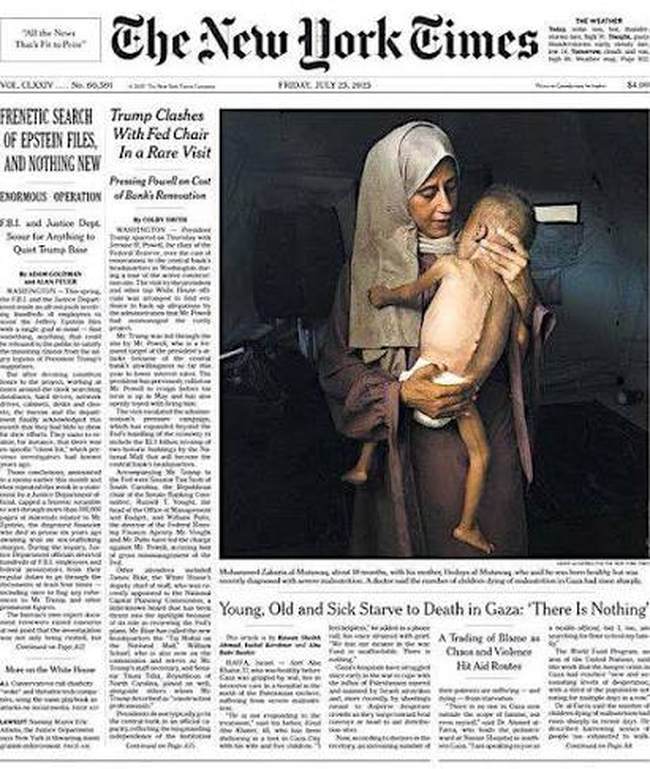
Kahn was even challenged by some of his colleagues for printing deceptive photos by his own colleagues. Why, if starvation was real, did they need photos of children who weren't actually starving? Kahn, though, had no shame, and published the lies anyway.
When they tried to make us believe that Israel deliberately bombed a hospital whose parking lot was hit by an errant Palestinian Islamic Jihad rocket, they printed a photo of an entirely different scene right there on the front page, shocking the conscience of people who thought they were being told the truth.
The rape dog story couldn't even be created as a credible hoax. It was that bad. If even Joe Kahn couldn't get behind the hoax, you know it was too ridiculous to print.
Except for the Opinion section of the Times. Their standards aren't even limited by plausibility, since their readers are actively seeking misinformation intended to confirm their priors, and the Opinion section is happy to provide them.
Editor's Note: Do you enjoy HotAir's conservative reporting that takes on the radical left and woke media? Support our work so that we can continue to bring you the truth.
Join HotAir VIP and use promo code FIGHT to receive 60% off your membership.








Join the conversation as a VIP Member