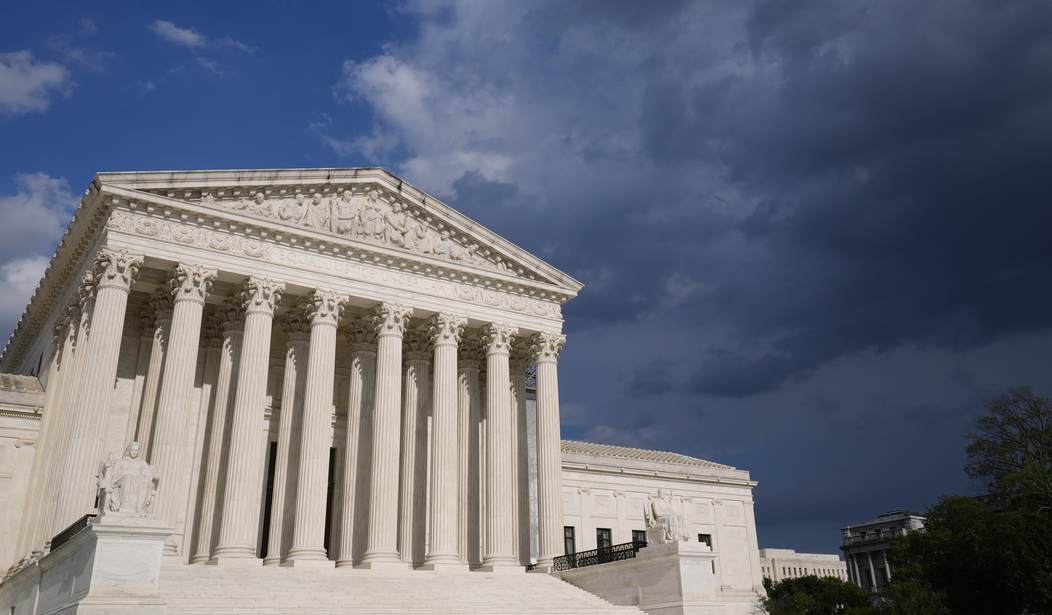
Just how dead are Donald Trump's tariffs? Are they only mostly dead, or did the Supreme Court take them to the "go through their pockets and look for loose change" status?
The 6-3 decision this morning at least makes them mostly dead. However, it won't take Miracle Max to revive them in the short run. The real question after this ruling from Chief Justice John Roberts will be how much blaving will take place at the State of the Union address this coming Tuesday:
The 6-3 decision, written by Chief Justice John Roberts, removes a tool of diplomatic pressure that Trump has aggressively wielded to remake U.S. trade deals and collect tens of billions of dollars from companies importing foreign goods. The ruling didn’t directly address whether the government will have to pay back the tariff revenue it has already collected.
It is the first time the high court has definitively struck down one of Trump’s second-term policies. In other areas, the court’s conservative majority has so far granted Trump broad latitude to deploy executive power in novel ways, but a majority of justices—three conservatives and three liberals—said he went too far in enacting his most sweeping tariffs without clear authorization from Congress.
Three conservative justices—Clarence Thomas, Samuel Alito and Brett Kavanaugh—dissented.
The case involved two categories of tariffs. Trump imposed one category on virtually every country in the world, ostensibly to repair trade deficits. He imposed the other set of tariffs on Mexico, Canada and China, saying those countries are responsible for the flow of illegal fentanyl into the U.S.
The court rejected Trump’s argument that a 1977 law, the International Emergency Economic Powers Act, implicitly authorized both groups of tariffs.
Note well that the IEEPA exists for emergencies. Trump's broad use of it to advance a general foreign policy preference makes it clear that this is his preferred standard policy (as do his public remarks), not an emergency with a presumed end date. Trump did indeed declare emergencies on both drug trafficking and trade deficits, Roberts notes in his ruling, but erratic and broad application to all American trading partnerships undermines that claim to a true exercise of emergency authority. Roberts notes that IEEPA "emergencies" tend to go on for decades, which already makes that justification questionable, let alone when assuming a rather large transfer of constitutional authority through such an open-ended claim.
And that is the real problem. The IEEPA never delegates either tariff or tax authority to the president, only the authority to "regulate" imports. Regulation does not include those specific authorities, which are explicitly granted to Congress by the Constitution:
To begin, IEEPA authorizes the President to “investigate, block during the pendency of an investigation, regulate, direct and compel, nullify, void, prevent or prohibit . . . importation or exportation.” 50 U. S. C. §1702(a)(1)(B). Absent from this lengthy list of powers is any mention of tariffs or duties. That omission is notable in light of the significant but specific powers Congress did go to the trouble of naming. It stands to reason that had Congress intended to convey the distinct and extraordinary power to impose tariffs, it would have done so expressly—as it consistently has in other tariff statutes. See supra, at 8; accord, post, at 11, 26–27 (opinion of KAVANAUGH, J.).
The power to “regulate . . . importation” does not fill that void. “Regulate,” as that term is ordinarily used, means to “fix, establish, or control; to adjust by rule, method, or established mode; to direct by rule or restriction; to subject to governing principles or laws.” Black’s Law Dictionary 1156 (5th ed. 1979); see also Ysleta del Sur Pueblo v. Texas, 596 U. S. 685, 697 (2022). This definition captures much of what a government does on a day-to-day basis. Indeed, if “regulate” is as broad as the principal dissent suggests, post, at 10–11, then the other eight verbs in §1702(a)(1)(B) are simply wasted ink. But the facial breadth of “regulate” places in stark relief what the term is not usually thought to include: taxation. The U. S. Code is replete with statutes granting the Executive the authority to “regulate” someone or something. Yet the Government cannot identify any statute in which the power to regulate includes the power to tax. The Government concedes, for example, that the Securities and Exchange Commission cannot tax the trading of securities, even though it is expressly authorized to “regulate the trading of . . . securities.” 15 U. S. C. §78i(h)(1); see Brief for Federal Parties 31–32. We are therefore skeptical that in IEEPA—and IEEPA alone—Congress hid a delegation of its birth-right power to tax within the quotidian power to “regulate.”
Emphasis mine. The dissenters insist that regulation includes the power to tax, but the Trump administration had the opportunity to provide case law on that point and failed to provide even a single example. The Constitution itself is clear on this point; only Congress has the power to tax or impose duties. It's the very first authority granted to Congress in Article 1, Section 8:
The Congress shall have Power To lay and collect Taxes, Duties, Imposts and Excises, to pay the Debts and provide for the common Defence and general Welfare of the United States; but all Duties, Imposts and Excises shall be uniform throughout the United States[.]
This is not an esoteric point in the separation of powers, either. The power to impose duties is the power to create revenue streams, and the framers of the Constitution understood the dangers of allowing the executive as both head of state and head of government its own independent revenue. Kings had those powers before Parliament became supreme in England, and for a while afterward as well. Trump and his team had proposed at times that he could exert full authority over tariff revenue without seeking approval from Congress, which makes this a very apt concern about crossing those boundaries. Tariffs imposed by Congress create revenue streams they control, and can then appropriate as they see fit, allowing them to use the power of the purse to oversee and check executive authority.
This is the reason I have always been skeptical that Trump would succeed in a challenge to these tariffs, at least under the emergency powers of the IEEPA. However, that's not the only way in which Trump could justify these tariffs. Jonathan Turley reminded Fox viewers that Trump has other statutes on which he can rely, although those come with restrictions, and Bruce Mehlman laid them out on Twitter as well:
JONATHAN TURLEY: "There's a lot of runway still for the administration..."
— Townhall.com (@townhallcom) February 20, 2026
"The administration has other tools in its toolbox. It CAN actually impose tariffs under other statutes!" https://t.co/xGN3evQLch pic.twitter.com/Kya76PnD6y
There will be tariffs. Even without IEEPA, the existing tariff toolbox is robust. https://t.co/PrMuGX4gV2 pic.twitter.com/ZWWMELJvdz
— Bruce Mehlman (@bpmehlman) February 20, 2026
That much is true, but it's also ... complicated. In May of last year, when courts began ruling against the use of the IEEPA for Trump's tariff authority, I reviewed these options. In some ways, Trump would be on stronger legal ground, but these options limit his range of action – and require congressional approval at some point. On Sections 232 and 301:
Trump could be on stronger ground with the two laws mentioned, but those also come with significant limitations. First off, the tariff potential is capped at much lower rates than Trump attempted to impose on trading partners in his Liberation Day rollout under the IEEPA. Second, any tariffs imposed will have time limitations unless Congress votes to adopt them ...
There is more flexibility on rates under other sections of the 1974 Trade Act, but the White House would have to conduct investigations to justify the punitive measures and pinpoint the behaviors that have to change in order to reverse the tariff actions. The first Trump administration used that approach with China and got what it wanted, but it takes time and preparation to implement such actions. It took nearly three years for Trump to finally escalate tariffs on China in the first term under these other statutes[.]
Mehlman also mentions Section 338, which is part of the Tariff Act of 1930, better known as the Smoot-Hawley Tariff Act, largely blamed for worsening the economic crisis and accelerating the Great Depression. That not only has the stench of nearly a century attached to it, it also has never been used in the manner Trump envisions:
Take special note of the fact that presidents have never used this law in the 95 years of its existence. That actually makes it a little more attractive for Trump in that there are no court precedents that might stand in his way. However, this law also carries a maximum tariff rate of 50%, according to Goldman Sachs and noted above, and only if Trump can prove discriminatory conduct. Even stacking the tariffs in these provisions gets Trump to just 65%, well below some of the threatened rates, and at least some of that would expire in 150 days whether Trump cuts a trade deal or not.
It's still law, however, and may be useful in this moment to validate the existing trade deals Trump has already made. He could use these authorities to get to the agreed tariff levels with countries like India, just to use one example, and force importers to start their challenges over again, with less hope of winning the next time. Congress could approve these trade deals and remove the legal impediments to enforcement, albeit by making sure they control the revenue generated by the duties imposed. That will be true with most of the options still left on the table after this ruling.
In short, this is a rational defense of clear constitutional issues. The Trump administration was taking a flier on the IEEPA all along, hoping to give Trump maximum flexibility, but in the end, the Constitution is clear. Only Congress has this authority, and they have only delegated it to the executive branch in limited ways in all of these Plan B statutes, and not at all under the IEEPA.
Now let's see what Trump has to say to Roberts et al when they show up for the State of the Union speech. We may need to revisit our criticism of Barack Obama for his conduct after Citizens United.
Addendum: I owe Duane "Generalissimo" Patterson and David Strom thanks for some notes on this. In our Week in Review episode this evening, Duane and I have an impassioned debate over this ruling, so be sure to watch it!
Editor’s Note: The 2026 Midterms will determine the fate of President Trump’s America First agenda. Republicans must maintain control of both chambers of Congress.
Help us continue to report on the Democrats’ radicalism and inform voters as our nation faces a crossroads. Join Hot Air VIP and use promo code FIGHT to get 60% off your membership!











Join the conversation as a VIP Member