Donald Trump's ceasefire extension expires this weekend. J.D. Vance's plane remains on the tarmac. Steven Witkoff and Jared Kushner will go to Islamabad, apparently, although not with much hope of engagement:
U.S. President Donald Trump's special envoy Steve Witkoff and son-in-law Jared Kushner will travel to Pakistan soon for talks with Iran's foreign minister, a U.S. official told Reuters on Friday.
Vice President JD Vance is not currently planning to attend but he will be on standby to travel to Islamabad if negotiations progress, according to CNN, which first recorded the travel plans.
In other words, they will be on hand if Iran's regime decides to get serious at the eleventh hour.
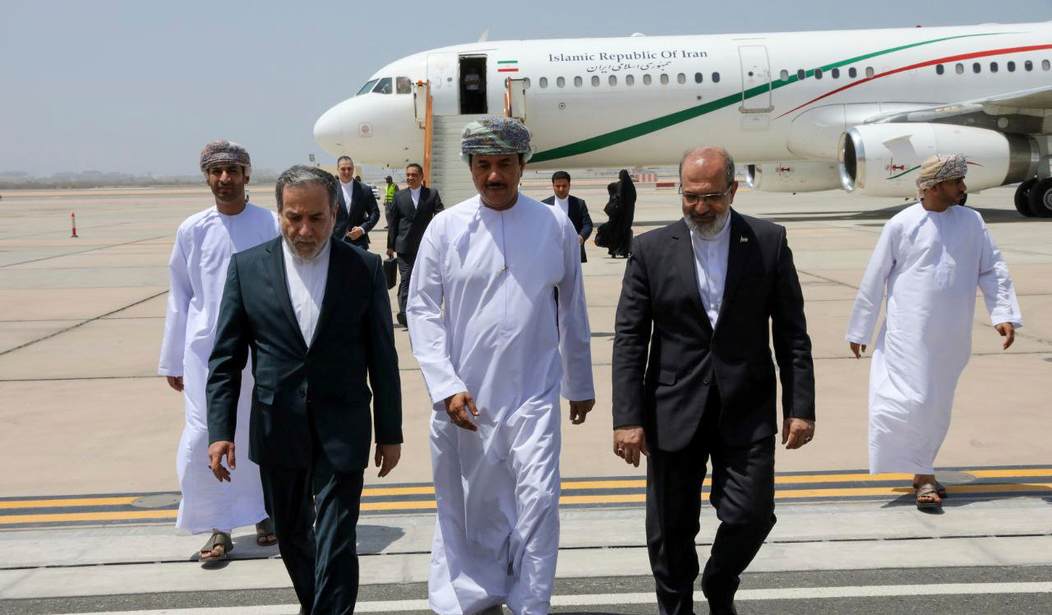
Abbas Araghchi has no plans to get serious, however. With the IRGC military junta refusing to negotiate on any of the American demands, especially nuclear enrichment and uranium stores, Iran's foreign minister has suddenly appeared in Islamabad. Araghchi has arrived for "bilateral consultations" with Pakistan, likely to implore his counterparts to convince Trump for another extension:
Senior Iranian leadership will come to Pakistan Friday or Saturday — as the world watches and waits for Tehran to agree to a second round of peace talks with the US, Iranian and Pakistani government sources told The Post.
Iranian Foreign Minister Abbas Araghchi will lead a “small delegation” to Islamabad, which is set to arrive around 10 p.m. local time Friday, an Iranian source said.
The meeting will most likely be bilateral between Islamabad and Tehran only, an Iranian source said.
What purpose would that serve? Pakistan isn't part of the US-Israel war with Iran, and except for a couple of attempts in the early days, it has not been the recipient of Iranian retaliation, unlike the experiences of Iran's Persian Gulf neighbors. Pakistan has good relations with the US – not as good as those GCC states, but warm enough, especially after Trump brokered a peace agreement after war briefly broke out between Pakistan and India.
Araghchi doesn't need "consultation" with Islamabad to know what steps Iran has to take to end the war. They have to surrender their highly enriched uranium (HEU), end support for terror proxies, renounce their illegal claim to sovereignty over the Strait of Hormuz, and negotiate missile limits with Israel and the countries in the Abraham Accords. Araghchi's problem is that he doesn't have any power to negotiate on any of those points, because the IRGC has depantsed him publicly and made sure everyone knows he's an impotent boob with an airplane at his disposal, and that's all.
Araghchi likely knows that Trump won't extend the ceasefire as another favor to Pakistan. That's why he's adding a couple of other stops on his "consultation" tour:
Iran’s Foreign Minister Araghchi:
— Open Source Intel (@Osint613) April 24, 2026
Touring Islamabad, Muscat and Moscow for regional consultations. pic.twitter.com/f2mbP4P8US
The Omanis have no draw whatsoever in Washington, having been Tehran toadies for a long while. Araghchi probably hopes that Vladimir Putin will weigh in more directly in the conflict as a way to force Trump into retreat. The problem with that strategy is that Putin still has his hands full with Ukraine. Trump might bite on a comprehensive settlement that includes both countries, but Putin would have to make some serious concessions now to get Trump on board – and the IRGC would still have to verifiably surrender its HEU stocks no matter what. Araghchi can't deliver on that, not to Putin or anyone else.
Besides, the clock is ticking on Iran's position. The blockade is strangling the regime of its income, and the inability to export oil is about to cause catastrophic damage to that industry that could last decades. The regime has recommissioned an old tanker moored at Kharg Island in a last-ditch effort to store its output before storage limits force the IRGC to start capping wells that may never produce again:
Iran is reportedly moving to expand crude storage at Kharg Island by reactivating the 30-year-old very large crude carrier M/T Nasha, a sign that the country’s main oil hub is nearing its onshore storage limit amid the US blockade of Iranian ports.
Maritime analysts say the vessel, which had been anchored empty for years, is being repositioned as floating storage to absorb crude that still has to move out of the system. ...
Analysts estimate roughly 13 million barrels of spare onshore storage remain at the terminal, while net inflows are running at about 1.0 million to 1.1 million barrels per day.
At that pace, storage could be filled in about 12 to 13 days, which places the saturation point in late April if current flows hold.
That matters because once storage fills, Iran would have to start shutting in wells, especially in water-injection fields that require steady operation to avoid damage and long-term production losses.
In essence, time is running out on the IRGC in two ways. Trump's ceasefire will expire this weekend, and thus far he's not been inclined to extend it. Even if he does, though, the blockade sets up a ticking time bomb that will not just strangle the regime economically now but for the next couple of decades. That may set up a third time limit, too – a deadline for when other factions in Iran decide that the IRGC has to go in order to salvage what's left of the country's economy and security.
That last timer may explain why Araghchi has decided to leave the country at this precise moment in time. If the stuff's ready to come down, at least he'll be outside of the circular firing squads, and may be able to position himself in a successor regime, depending on who seizes power in an IRGC collapse.










Join the conversation as a VIP Member