Note: This was written earlier this afternoon, before events began providing evidence for my theory of the friction between the US and Saudi Arabia.
On Sunday, the US Navy launched Project Freedom, the military operation to provide a "red white and blue dome" over international waters in the Strait of Hormuz. On Monday, War Secretary Pete Hegseth and Joint Chiefs chair Gen. Dan Caine presented the defensive operation enthusiastically at a regular media briefing. Donald Trump warned Iran that any interference with the reopening of the Strait would result in its regime being "blown off the face of the earth."
By late Tuesday, however, Trump reversed himself and ordered a "pause" on Project Freedom. He declared that recent diplomatic initiatives from Iran were substantive enough to halt the effort to free up commercial shipping. THat had supporters of Trump and the war scratching their heads, and for good reasons. NBC News reported late yesterday that the diplomatic movement came from the Saudis, who reportedly refused to grant access to their airspace for Project Freedom and pushed Trump back into talks moderated by the Pakistanis instead:
Trump surprised Gulf allies by announcing “Project Freedom” on social media Sunday afternoon, the officials said, angering leadership in Saudi Arabia. In response, the Kingdom informed the U.S. it would not allow the U.S. military to fly aircraft from Prince Sultan Airbase southeast of Riyadh or fly through Saudi airspace to support the effort, the officials said.
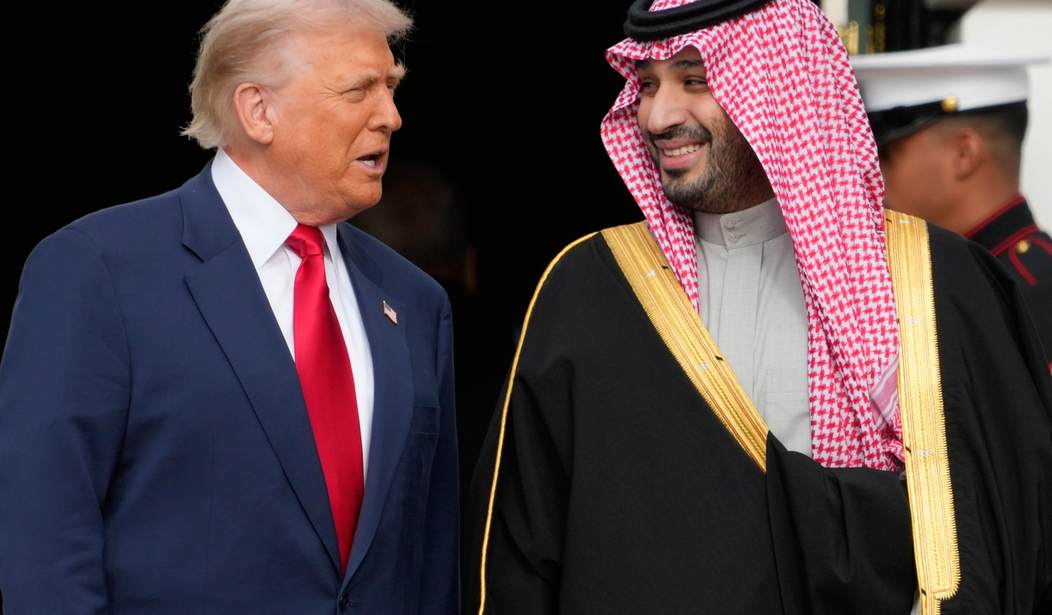
A call between Trump and Saudi Crown Prince Mohammed bin Salman did not resolve the issue, the two U.S. officials said, forcing the president to pause Project Freedom in order to restore U.S. military access to the critical airspace. ...
Asked whether the announcement of Project Freedom caught the Saudi leaders by surprise, the Saudi source said: “The problem with that premise is that things are happening quickly in real time.” The source said Saudi Arabia was “very supportive of the diplomatic efforts” by Pakistan to broker a deal between Iran and the U.S. to end the war.
Other reports suggest that the Saudis are not happy with the lengthy pause, nor the extemporaneous nature of Trump's tactics in the theater. The lack of response to Iran's attack on the UAE may have played a role in Mohammed bin Salman's decision to cut off access to Saudi airspace too, as the Saudis would be the next target on Iran's list if hostilities started inching up incrementally. The US could probably enforce the Project Freedom "dome" with naval aviation assets alone, but it would complicate the operation and may not suffice given the amount of missiles and drones that the IRGC still has in its arsenal.
The Wall Street Journal reported on the sudden confidence drop Tuesday evening, after Iran fired a series of salvos despite the ceasefire agreement. Hegseth and Caine declared that the attacks didn't meet Trump's threshold for an escalated response, and that appears to have rattled our allies:
President Trump chose to look the other way after Iran launched three salvos of missiles and drones into the United Arab Emirates, one of America’s main Middle Eastern partners, despite a cease-fire he negotiated nearly a month ago.
The likely conclusion in Tehran, Gulf governments fear, is that further escalation pays off because Trump is so intent on extricating himself from the war that he will ignore renewed Iranian attacks on America’s regional allies.
European and Asian nations—allies and strategic adversaries alike—are watching this closely, too.
I warned about this at the time Caine made his remarks:
“No adversary should mistake our current restraint for a lack of resolve,” Caine added in a joint briefing with Defense Secretary Pete Hegseth, who talked up the U.S.’s efforts to free up the flow of ships through the Strait of Hormuz.
Ahem. One has to wonder whether the administration has really taken the proper measure of their enemies in the field with statements like Caine's. Iran has spent 47 years correctly assessing that American restraint showed a lack of resolve. Operations Midnight Hammer and Epic Fury might have begun to force a reassessment, but allowing Abbas Araghchi to stall for time while offering nothing makes it look very much like the US has a resolve deficit. The military junta only understands power and will only respond to brutal applications of it.
And again later in the evening:
Ahmad Vahidi rejects the idea that he has two choices. He thinks he has a third – to outwait Trump and force the US to back down. The longer Trump allows the IRGC to delay choosing between these two options, the stronger the case becomes for the third. This is what I meant earlier today when I worried that the administration didn't understand this enemy, who sees any restraint as weakness. Weakness creates options and fractures, which Trump should know, since he's counting on weakness and fractures to collapse the IRGC. Waiting likely won't help.
The IRGC isn't the only power in the region keeping a close eye on a "resolve deficit." Trump had gotten the entire Gulf Cooperation Council on board with the war after Iran started attacking those states because Trump had demonstrated reliable resolve in the first six weeks of the war. Ever since the ceasefire, though, Trump has given the appearance of a leader who wants to bail out rather than impose his will on the situation, and that may have MBS and others looking for the cheapest way out regardless of whether it resolves the dangers that the IRGC poses in the region. The UAE may be the only state still demanding action at this point, at least until Trump decides if he wants to see this all the way through.
Now the Saudis have backed all the way off enforcement. They won't risk their energy infrastructure again if Trump won't fight back against Iran's attacks. And why would they?
With this in mind, let's return to the proposal that Trump reportedly offered. It's actually not different from earlier American proposals, except that the sequencing is looser and Trump has offered a quicker access to a carrot or two. The basic structure is still the same – turn over the highly enriched uranium, accept a moratorium on enrichment at any level for 20 years, and commit to full verification of those concessions before ending the war. Trump insists that Ahmad Vahidi will take this deal, but that seems very unlikely.
That prompts the question: Is this proposal designed to fail? Did Trump send this to Pakistani mediators to force Vahidi to publicly reject it again? That might give Trump leverage to gain MBS' support for renewed military operations, but only as long as Trump recommits to ending the IRGC regime and seeing the war to its conclusion. MBS won't sacrifice years of repair and restoration just to see Vahidi sitting pretty across the Persian Gulf for the next several years, and Trump had better understand that now.
We do have an early data point in favor of this hypothesis:
NEW 🔴
— Open Source Intel (@Osint613) May 7, 2026
Saudi Arabia and Kuwait have reopened access to U.S. military bases and airspace, paving the way for Washington to resume escort operations in the Strait of Hormuz.
The restrictions were introduced after Gulf states grew concerned over possible Iranian retaliation and…
The restrictions were introduced after Gulf states grew concerned over possible Iranian retaliation and doubts surrounding U.S. security guarantees following recent regional attacks.
U.S. officials say the naval protection mission for commercial shipping could restart as early as this week.
If the Saudis thought Iran would cut a deal, both they and the Kuwaitis would keep their airspace closed. Allowing US forces to transit through it for Project Freedom assumes Iranian opposition will remain in place. Perhaps MBS got a firm commitment from Trump to stop extending the ceasefire after this round of talks inevitably fails.
Hugh Hewitt interviewed Trump earlier this week, and was nonplussed enough by Trump's response to pen an op-ed for Fox urging Trump to renew his resolve to see this through to victory:
The "leaders" left standing in Iran (the ones with the guns at least) are fanatical killers who cannot be trusted. The blockade should stay in place until full commercial traffic to every country not named Iran resumes through the Gulf. The repudiation of enrichment has to be complete and the remains of the highly enriched uranium, now buried under rubble at various sites after U.S. precision strikes, has to be dug up and turned over to us. The Iranian missile and drone programs must have caps on the number of missiles and their range, and those programs must be subject to a strict verification regime. Finally, the regime must turn on the internet for its people and turn off the money spigot for Hamas, Hezbollah and the Houthis.
These are reasonable demands and the fanatics in Iran — unless they are irrational (they may be) — must see them as such. President Trump doesn’t surrender leverage. He’s got it. We have to hope he uses every ounce of it.
Special Envoys Steve Witkoff and Jared Kushner don’t want their names on a "second Munich agreement," and they have walked away before. President Trump should not want to risk the victory he has won that is one for the ages by letting Iran off the floor.
Perhaps this latest diplomatic detour isn't designed to get a deal from Vahidi but another deal from Mohammed bin Salman. At least that would make sense. This pause and the continuous lack of reaction to IRGC provocations and violations of the ceasefire stopped making sense days ago otherwise.