Now, I know that Colorado has dipped over into the deep blue of woke progressivism on the social side of the house. I've done some pieces here on their coddling - or ignoring - issues like their burgeoning illegal gang problems, with Venezuelan thugs taking over apartment complexes and not admitting it until months later.
They've even gone a little nutso wanting to control how many paper napkins (that would be 'NONE') and packets of hot sauce you're handed without asking for them when you get a take-out meal.
Okay - we can acknowledge that's pretty certifiable.
And I guess it's all fun and Rocky Mountain High games played with the voters who elected these bozos until the regulation-palooza starts spreading like a malignant virus and impacts the bottom line of businesses in the state. By their nature, most businesses can absorb a fair amount of abuse, particularly if they're a member of that 'evil corporation' class as opposed to a more fragile mom-and-pop-sized small business with less flexibility and operating capital.
But they all share similar characteristics of doing everything they can to maintain their presence in the community where they've established themselves. Picking up and relocating is not easy and often not a feasible alternative.
What is happening in Colorado right now is a rerun of the warning flags that flew and the alarms that the business community in California tried to raise with their lawmakers, both local and at the state level, which have been ignored and rebuffed for the past decade to the state's great detriment.
Businesses in Colorado are leaving. The ones who are still there are doing their level best to explain to the powers that be why they are pulling out.
The regulatory climate and overall costs are driving businesses either under or away to other states.
A new relocation report from the Colorado Chamber of Commerce wasn’t promoting the reasons companies should move to the state. It wasn’t an appeal for new members. And it certainly wasn’t about the weather.
The 2025 Relocation Tracker report focused on how challenging it has become for businesses in Colorado. It named 98 companies that have left Colorado since 2019 or bypassed the state for opportunities elsewhere. That totaled 13,607 jobs “lost to other states.”
The latest report is part of the chamber’s 10-year plan launched a few years ago to use data and research to figure out how to improve the business climate in Colorado, said Rachel Beck, executive director of the Colorado Chamber Foundation.
The organization hired two economists to help track data. They also looked at other reports like CNBC’s annual ranking of “America’s Top States for Business,” which started in 2007. Colorado was in the top 10 states for 15 years (often in the top 5) until 2023, when it fell to 11th. Then to 16th in 2024. Last year, Colorado was back up to 11th.
From 2022’s finding that “state-level policies have driven some companies to look to other states for expansions,” Colorado today is “lagging behind other states when it comes to key business metrics, from the cost of doing business to cost of living,” according to the report.
“We are the sixth-most regulated state in the country and the rate of regulations is growing at a faster rate than the rest of the country,” Beck said. “We continually hear from our businesses that it’s the volume (of proposed laws). Just keeping up is a big part of the problem.”
The hits keep coming.
And people wonder why businesses are leaving CO. Not to mention the billions upon billions in manufacturing going to other states who are business friendly unlike CO.
— Colorado Republican Party (@cologop) March 25, 2026
Thank a CO Dem 😃 though https://t.co/hxptedZcUu
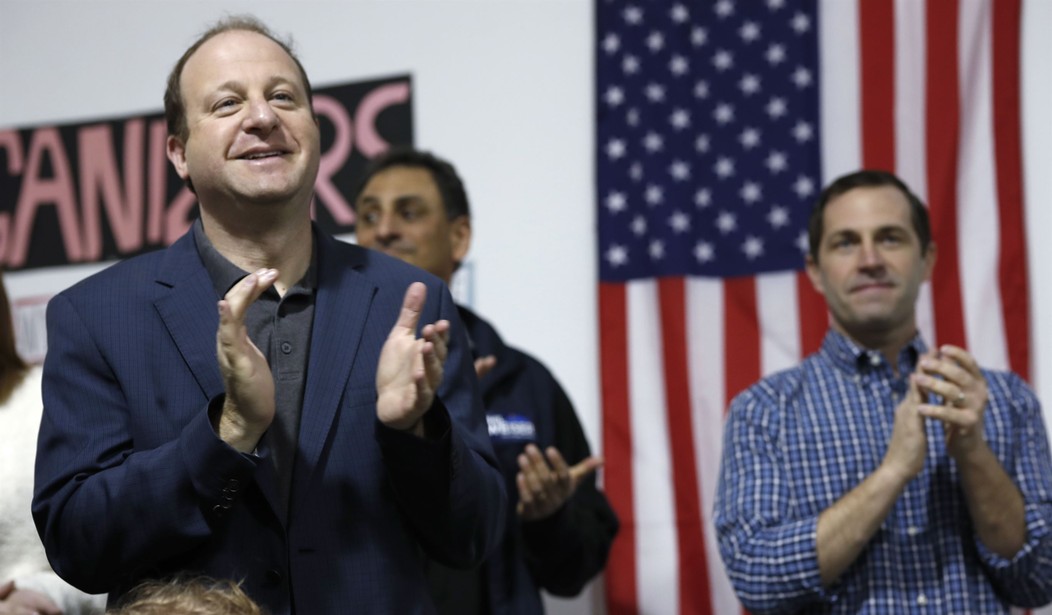
And sometimes, they make so little sense, such as the legislation passed that drove Palantir out of the state to new headquarters in Florida. It was recently cited in a letter written to Governor Jared Polis (coincidentally, signed by the governor, too - that's how freaky schizo these CO politicians are) by more than 200 state industry and tech leaders.
Is Colorado scaring away corporate expansions and entrepreneurs that had once made the state a magnet for high-tech business growth?
That’s the assertion of a letter signed by more than 200 business and technology leaders, addressed to Gov. Jared Polis, Denver Mayor Mike Johnston, Democratic senatorial candidates and other political leaders.
Notably, one of the signers is Polis himself.
Boulder entrepreneur Dan Caruso told The Denver Gazette that after he drove an effort to draft the missive, warning that political messaging is damaging the state’s business competitiveness, Polis had reached out.
...The letter, titled “Ensuring Colorado’s Innovation Future,” followed an April 6 report by the Colorado Chamber Foundation that showed Colorado had suffered a net loss of 34 public company headquarters since 2022.
...The new letter from business leaders specifically pointed to the state’s recent loss of Palantir Technologies, the defense-related software firm estimated to be valued at more than $300 billion. The company announced it was pulling out of Colorado in February, headed for Florida.
That move had been widely attributed to passage of an “algorithmic discrimination” law by the Colorado legislature in 2024, which seeks to hold employers liable for discrimination resulting from use of AI tools.
Caruso told The Denver Gazette that the bill stood out as “the most glaring” example of recent policy decisions that sent the wrong message to companies and investors considering where to expand.
Noting that he has extensive contacts among policymakers, Caruso said that he had tried to get the bill changed.
“They chose not to repeal it and start over, which is what I advocated,” he said.
I would ask what a definition of 'discrimination resulting from AI tools' was, then again, I don't really want to know.
These entrepreneurs and established firms alike both look at what had been a nurturing environment for their companies, and see that evaporating with every new tax and regulation, very much as I imagine Silicon Valley felt as their golden goose got cooked.
...“This ecosystem was built by entrepreneurs, risk-takers, research institutions, capital providers, and forward-looking public leadership,” it continued.
“Despite the extraordinary progress of the past two decades — and despite these enduring structural advantages — the foundation of Colorado’s technology and business leadership is deteriorating,” the letter said, adding, “When business leaders evaluate where to launch their next startup, relocate headquarters, expand manufacturing, or deploy significant capital, Colorado is categorized as carrying structural disadvantages that introduce unnecessary risk.”
If changes aren’t made in the perceptions being created, Caruso told The Denver Gazette, “turning the ship around will be very difficult.”
And in the discussions, they wield probably the worst insult imaginable to make their point - don't, they beg, turn us into Chicago.
...What is the worst that could follow if warnings are ignored and the state’s direction stays its present course?
“Boulder starts looking like Chicago,” Caruso said, adding similar parallels about business perceptions of New York, Boston and California. The latter, Caruso suggested, evinces a “you’re welcome to move elsewhere” takeaway.
That should leave a mark - you'll notice I said 'should.' Because it won't.
The governor and his toadies in the legislature are big on sympathetic lip service. That's about all.
...Let’s be clear: Higher costs and more government spending sap economic growth and drive businesses away.
Polis talks a good game about cutting income-tax rates as “the most effective way to further our economic growth.” But while he pays lip service to eliminating Colorado’s income tax, he’s never actually proposed it — or a bill to simply cut rates. He’s merely endorsed ballot measures sponsored by conservative organizations.
Meanwhile, the Democratic legislature has passed numerous “fees” without letting the people vote. Those include fees established in SB21-260 — ostensibly for transportation but actually directed at “environmental mitigation” — slapped on every Uber ride, Amazon package, UPS shipment, and DoorDash delivery, plus rental cars and gasoline (on top of the gas tax).
Who signed SB260 into law? Jared Polis.
Lawmakers passed the 10-cent bag fee and new “fees” on energy producers — hammering an oil and gas industry that was already burdened by the nation’s strictest regulations under SB19-181. Now, it’s squeezed even more due to the Iran conflict.
Those fees and regulations? Signed by Jared Polis.
The state’s Public Utilities Commission adopted a “clean heat plan” forcing gas utilities to slash emissions 41% by 2035, costing ratepayers billions.
Who appoints the PUC’s commissioners? Jared Polis. Commissioners are following his agenda for net-zero by 2050, picking select green energy sources as “winners” over affordable oil, gas and coal.
But will it change anything in an ever-deepening blue state when the hostility to business is nearly at the baked-in point?
In absolute, not relative, terms, Colorado had FEWER new small business startups during the last available year of data than ANY OTHER STATE. Single-party rule by the Democrats has decimated the entrepreneurial ecosystem in the once great entrepreneurial state of Colorado. 😠 pic.twitter.com/OreQByA53F
— Mike O'Donnell (@modonnell) April 21, 2026
There are enough stresses in the job market in its own right between mergers and acquisitions...
PNC is laying off hundreds of employees in Denver within days of completing integration of FirstBank. https://t.co/SpR2tkuxFe
— Pittsburgh Business Times (@PghBizTimes) April 23, 2026
...without state legislature piling on more pressure, financial burdens, and regulations repeatedly, from napkins to emissions.
Manufacturing plants, petroleum refineries, and any facilities using gas-fired turbines must begin reducing emissions of five priority toxic air contaminants by 2027 under newly approved state regulations aimed at cutting the most unhealthy kinds of air pollution.
The Colorado Air Quality Control Commission on Friday completed a 15-month set of rulemakings that designated five pollutants for special regulations, boosted reporting requirements on TAC emissions, set health-based standards on the toxins and, finally, laid out ways in which companies must cut pollution. Affected firms must determine which of their facilities emit the TACs — benzene, formaldehyde, hydrogen sulfide, ethylene oxide and hexavalent chromium — at high enough rates to meet the applicability threshold and then must follow rules to reduce them.
A final two-day hearing to establish emission-control regulations brought about similar complaints as previous rulemakings, with regulated industries warning some rules are too stringent and environmental groups arguing that they don’t offer enough protection. AQCC members, however, expressed consensus on the regulations, saying they are technically feasible and use the state’s limited resources in the most efficient way possible.
“I’m very proud to be able to contribute to this,” said commissioner Gregg Thomas, the environmental quality division director in the Denver Department of Public Health and Environment who has worked on TAC controls since the late 1990s. “I feel like I could retire tomorrow and I’d be happy.”
Everyone's so surprised when out the exits they go.
Colorado is finding out what happens when politicians pile on taxes and regulations: businesses leave.
— The Market Institute (@MarketInstitute) April 21, 2026
Headquarters, jobs, and investment do not stick around where they’re punished. Colorado should reverse course before more opportunity walks out the door. pic.twitter.com/Aj1lcVdiyo
Colorado is well on its way to Chicago or California status, and no one will be more hurt and surprised than the people who drove them there.
Classic.